

Leadership grows stronger when you turn good intentions into observable behaviour. To improve leadership skills, seek specific feedback from colleagues, choose one behaviour to practise and review how your actions affect the team. Leadership means helping people work towards shared goals through clear communication, sound decisions and trust.
It’s natural to focus on your strengths, but other people can help reveal blind spots that are harder to see alone. This guide explains how feedback and simple measures can show progress, how coaching and mentoring can support development, and how inclusive habits help everyone contribute. You’ll find practical ways to listen, learn and lead with greater awareness, whether you’re developing in a formal role or preparing for your next step.
Key Takeaways
- Use feedback from colleagues, team members and managers to spot leadership strengths and blind spots, then practise a specific behaviour.
- Track progress through follow-up feedback, employee surveys and observable changes in how the team communicates and works together.
- Make coaching and mentoring more effective by setting clear development goals, practising between conversations and reviewing progress regularly.
- Build inclusion into everyday leadership by making space for different voices and acting on the perspectives people share.
1. How does 360 feedback help develop leadership skills?
Managers can start by developing clear communication, active listening and accountability. These skills shape daily expectations and build trust. To decide where to focus, compare feedback with a practical goal: clearer handovers, more useful one-to-ones or faster decisions. That gives your learning a visible purpose.
A 360 feedback process brings together perspectives from colleagues, direct reports and managers. Ask each group for examples of what you do well and where your behaviour creates friction. Anonymous surveys can help people share candid views. Compare comments for patterns, not isolated opinions. Managers rate leaders at least 20 percentage points below how leaders rate themselves for six of the seven leadership expectations. Treat that gap as a prompt for self-awareness, not defensiveness.
Establish a baseline before changing your approach. Ask a peer, team member and manager: “When did my communication help, and when did it slow the work?” Then choose one behaviour to practise, such as summarising decisions at the end of meetings. Reflect on feedback after each meeting and note whether responsibilities and deadlines are clearer. Learning agility means testing a change, reviewing the results and adjusting. This makes leadership development observable, not just an intention.
Build emotional intelligence and empathy by pausing before you respond, naming the concern you hear and checking that you’ve understood. For example, if a colleague challenges a deadline, listen for workload or dependency issues before defending the plan. This helps you adapt your response and build more open working relationships.
Use feedback to strengthen your influence as well as your clarity. State the outcome, expectations and decision owner, then invite questions and listen without interrupting. When negotiating a project deadline, explain the constraints, ask what matters to the other team and agree the next steps. Keep your promises and follow through. These habits connect open communication with trust and accountability.
2. How can organisations measure improvements in leadership skills?
Effective development combines practice, feedback and follow-up. Set a clear goal, such as improving delegation, then decide what evidence will show progress. Establish a starting point using team survey responses, performance reviews or examples of delayed decisions. After trying a new approach, gather fresh feedback and compare behaviour, team clarity and follow-through. This makes strengths and development needs easier to assess.
Organisations can support this process with challenging assignments, tailored training, peer learning groups and regular performance reviews. The Center for Creative Leadership’s development model attributes 70 percent of leadership learning to challenging experiences and assignments, 20 percent to coursework and training, and 20 percent to developmental relationships. Give managers opportunities to lead a project, reflect on decisions and discuss lessons with a peer. Reading and professional development add useful frameworks, but apply each idea to a real workplace challenge.
To develop decision-making and problem-solving, use a recent team challenge as a practice exercise. Ask the group to define the problem, list options, consider risks and explain its chosen course of action. Afterwards, review what happened and what could change next time. Avoid common mistakes: measuring attendance instead of changed behaviour, relying only on a leader’s self-assessment, or setting goals without follow-up. Leadership is improving when team members experience clearer decisions and consistent accountability.
For remote or hybrid teams, measure whether people understand priorities and can raise concerns across locations. Use regular one-to-ones, written project updates and team pulse questions, then act on recurring themes. For structured support, explore leadership development support that connects learning with workplace practice.
3. Coaching and mentoring
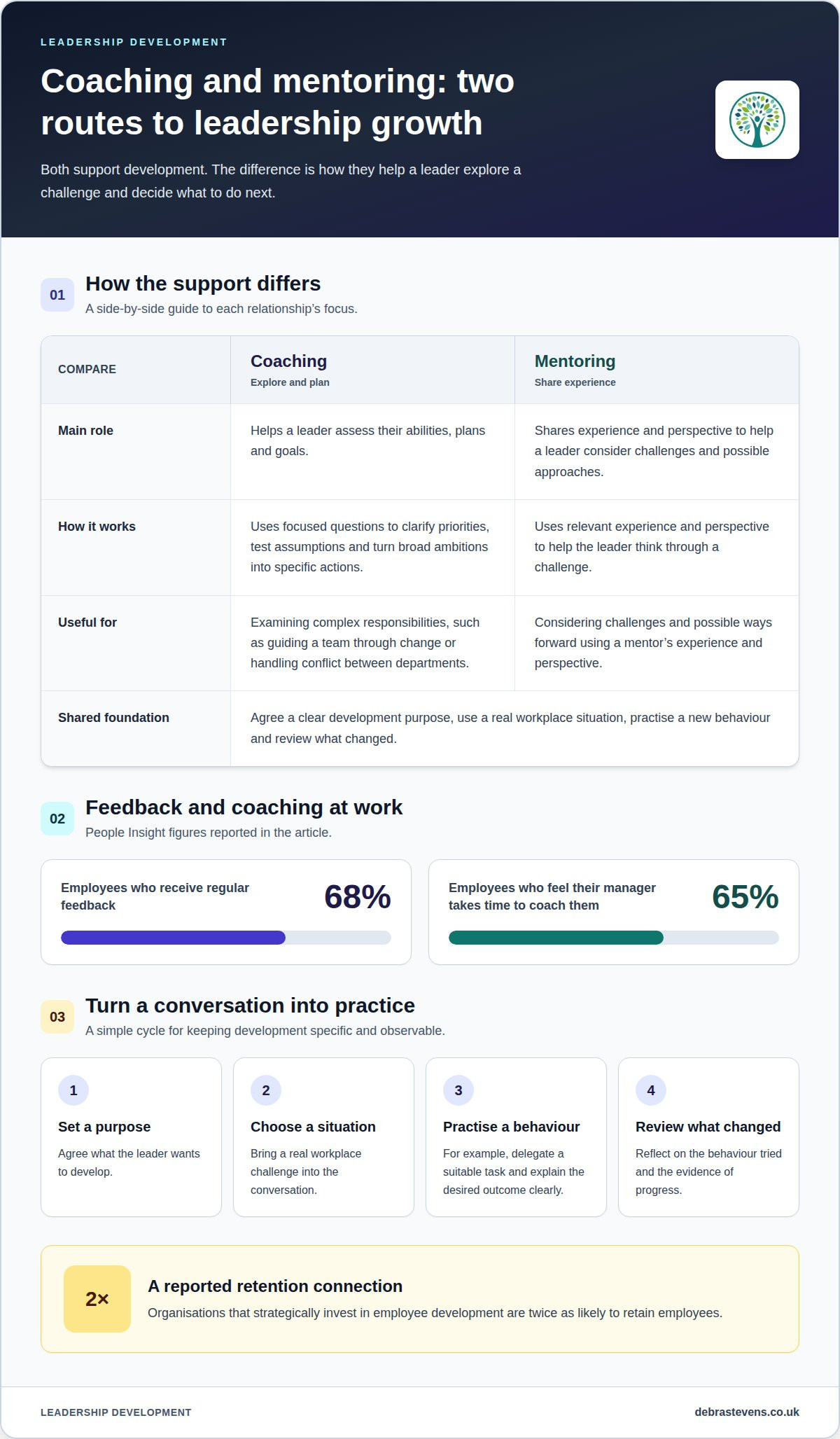
Regular coaching turns feedback into a practical development plan. People Insight reports that 68% of employees receive regular feedback, while 65% feel their manager takes time to coach them. Make conversations timely, specific and balanced rather than saving every observation for an annual review. For example, discuss how a meeting went soon afterwards, identify one effective behaviour, then agree what to practise next time.
Coaching and mentoring provide different kinds of support. A coach helps a leader assess their abilities, plans and goals through focused questions. A mentor shares experience and perspective, helping the leader consider challenges and possible approaches. Both relationships work best with a clear purpose. Agree what the leader wants to develop, choose a real workplace situation and review what changed after they tried a new behaviour.
Leadership development can help leaders examine complex responsibilities, such as guiding a team through change or handling conflict between departments. A coach can help clarify priorities, test assumptions and turn broad ambitions into specific actions. For example, a leader who wants to delegate more could identify a suitable task, explain the desired outcome clearly and then reflect on how much autonomy the team member used. This creates a practical basis for further feedback.
To build trust, keep coaching conversations consistent and follow through on agreed actions. Start each meeting by reviewing the previous commitment, then explore a current challenge and settle on a practical next step. Record the behaviour to practise and the evidence that will show progress, such as clearer delegation or more confident contributions in meetings. Organisations that strategically invest in employee development are twice as likely to retain employees. That makes coaching and mentoring valuable when leaders need sustained support, not a one-off conversation.
4. Inclusive leadership
Inclusive leadership makes participation a deliberate part of everyday decisions. Effective leaders don’t assume the loudest voice represents the whole team. In a planning meeting, invite each person to contribute before opening the discussion. Rotate who speaks first, and ask remote colleagues to share their views in chat or beforehand. These structures broaden the perspectives informing a decision.
Consult widely, then act on what you hear. If a team member says a new rota clashes with caring responsibilities, explore workable alternatives before finalising it. Explain which suggestions shaped the decision and why others weren’t adopted. Following through shows people their input matters, even when a proposal can’t be used. It can also help leaders identify barriers they might otherwise miss.
Inclusive leaders pay attention to patterns, not just individual exchanges. During a project review, notice whose ideas receive follow-up questions and whose contributions pass without discussion. Invite quieter colleagues to contribute without putting them on the spot, and make space for written input. If disagreement arises, summarise each position fairly before evaluating the evidence. This helps challenge assumptions without treating difference as disruption.
Inclusion also affects how leaders share opportunities. For a stretch assignment, explain the skills needed, invite expressions of interest and give clear reasons for the selection. Check that meeting materials are accessible and decisions are recorded where relevant colleagues can find them. These steps make expectations visible and reduce reliance on informal networks or assumptions about who is ready.
Training can help managers practise these behaviours through realistic workplace situations. Afterwards, choose one meeting habit to change, ask the team what improved and adjust based on their responses. Make inclusion part of routine leadership, not a separate initiative. Strengthen your approach with Diversity, Equity & Inclusion (DEI) Training that helps teams translate inclusive principles into everyday practice.
Debra Stevens Training and Coaching: Leadership & Management Training
Debra Stevens Training and Coaching’s Leadership & Management Training helps organisations turn leadership goals into practical workplace development. It’s a useful next step when managers want to strengthen communication, decision-making or team relationships through learning shaped around their organisation’s needs.
Experiential workshops use professional actors in realistic role-play scenarios. Managers can practise responding to workplace situations, reflect on their approach and explore different ways to lead. Conscious Human Skills Workshops can also develop the interpersonal skills that support effective leadership, including communication and collaboration.
To discuss a programme shaped around your team’s priorities, contact Debra Stevens Training and Coaching about your leadership development needs.
Turn your leadership goals into your next step
Leadership development moves forward when you choose a behaviour to work on and make time to practise it. If you’re considering how to improve leadership skills across your organisation, identify the conversations, decisions or team dynamics you want to strengthen. A clear focus helps turn new insight into everyday action.
Debra Stevens Training and Coaching offers Leadership & Management Training, Conscious Human Skills Workshops and The Why Factor. Explore these options in relation to the leadership challenges your team is facing, then discuss the outcomes you want to work towards. A conversation can help you consider a suitable direction for your organisation without committing to a one-size-fits-all approach. Contact Debra Stevens Training and Coaching to talk through your leadership development needs. Each thoughtful step creates an opportunity to lead with greater clarity, confidence and care.
Frequently Asked Questions
What is leadership?
Leadership means helping people make progress towards a shared purpose. It can involve setting direction, creating conditions for good work and adapting when priorities change. For example, a project lead might clarify the outcome, bring the right colleagues together and remove obstacles. Leadership is demonstrated through actions and relationships, not just a job title.
How Do Great Leaders Build Effective Teams?
Effective leaders build teams by matching responsibilities to people’s strengths and making collaboration part of the work. For a project launch, they can clarify who owns each decision, agree how information will be shared and make space for different expertise. They also notice when workloads or dependencies clash, then adjust plans so the group can deliver together rather than work in silos.
How Do I Create a Leadership Development Plan?
A practical way to improve leadership skills is to turn one workplace challenge into a development goal. Name the behaviour to practise, such as making decisions with incomplete information, and choose a real opportunity to test it. Set a review point, record what happened and decide what to keep or change. Include a colleague or mentor who can help you stay accountable.
How can organisations measure improvements in leadership skills?
Organisations can assess progress by reviewing leadership behaviours alongside relevant team or project outcomes. For example, a department focused on clearer delegation could check whether responsibilities are understood and work moves smoothly between colleagues. Compare evidence over time, while considering changes in context, such as a new project or team structure. This provides a more useful assessment than relying on a single measure.
How does 360 feedback help develop leadership skills?
360 feedback helps leaders compare how their behaviour is experienced by people in different working relationships. The value comes from examining patterns and specific examples, rather than treating every comment as a vote. If colleagues describe different experiences, consider the situations involved: a leader may communicate well in planned meetings but less clearly during urgent changes. That contrast can point to a focused area for development.
What role does coaching play in leadership development?
Coaching gives leaders structured time to think through challenges and choose practical actions. For instance, a manager preparing to address missed deadlines could explore the outcome they need, what might be driving the issue and how to open the conversation. A coach can help them test their approach and reflect on the result. The leader remains responsible for making decisions and applying what they learn.





One Comment