
Have you ever watched a helpful suggestion come across as criticism? Your intention was sound, but the conversation still went sideways. That gap between what you mean and what someone hears is where communication skills training can make a practical difference.
You probably already know that listening well, choosing your words carefully and adapting to the person in front of you all matter. The question is how to practise those skills so they hold up in real conversations, not just in theory. After 26 years in training, I’ve seen how a little reflection, a chance to try again and thoughtful feedback can help people notice what’s happening between them.
In this article, I’ll explain what communication training can cover, from workplace conversations and feedback to cross-cultural communication and presentations that make your message clear and memorable. Try a small experiment as you read: in your next conversation, ask one more question before offering your view. Then notice how it lands. What changes when you listen first?
Key Takeaways
- Build stronger conversations by listening for meaning, checking what you’ve understood and adapting your response.
- Shape practice around the conversations each role needs, from giving feedback to handling difficult discussions.
- Across cultural and language differences, make space for clarification and avoid assuming that one communication style suits everyone.
- Make presentations more impactful by giving your message a clear purpose and considering what you want your audience to understand or do.
What is communication training?
Communication training develops practical skills for clearer conversations, from listening carefully to responding with purpose. A useful course gives you the chance to practise, receive feedback and try a different approach.
Active listening
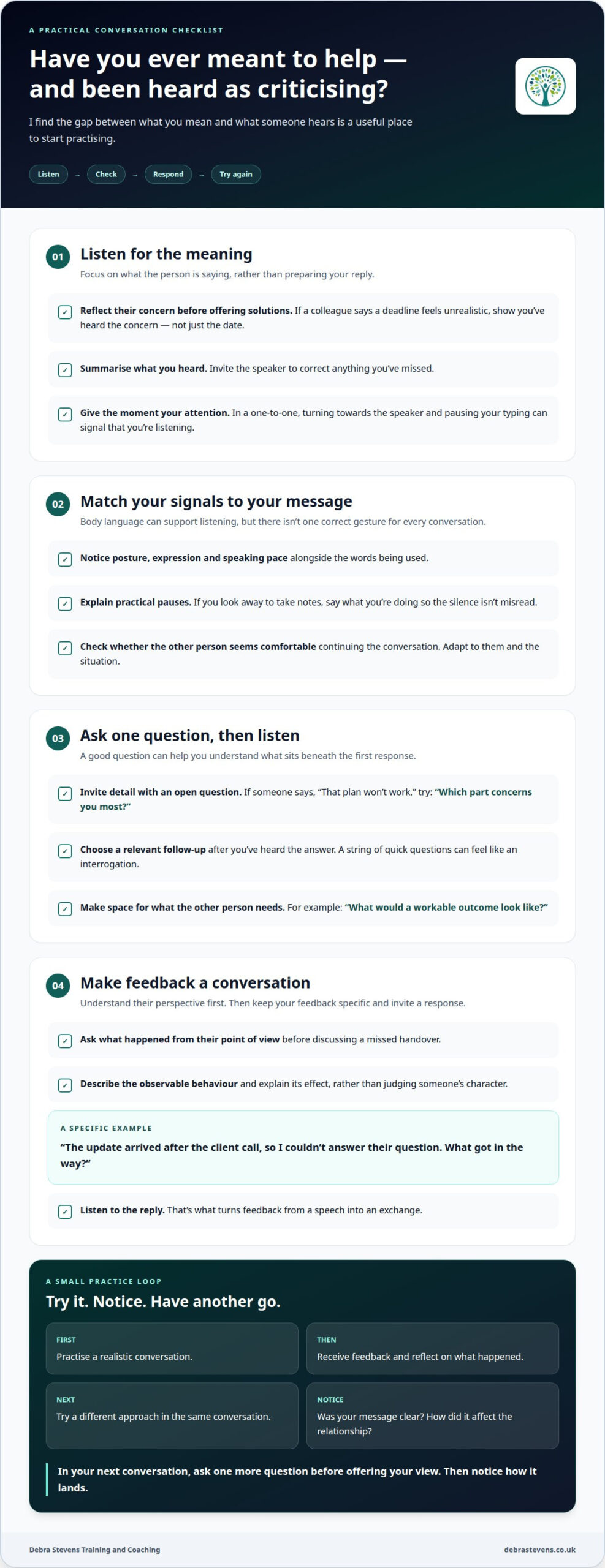
Active listening means focusing on the speaker’s message rather than preparing your reply. In a project meeting, for example, a colleague might say a deadline feels unrealistic. Reflecting their concern before offering solutions shows you’ve heard the issue, not just the date.
Look for practice that helps you notice key details and check your understanding. Summarise the speaker’s point, then invite them to correct anything you’ve missed. Repeating this in realistic conversations can build confidence without turning listening into a script.
Listening and body language
Body language can support listening, but it needs to suit the interaction. In a one-to-one conversation, turning towards the speaker and pausing your typing can signal attention. Looking away to take notes may be practical, so explain what you’re doing rather than letting the silence be misread.
Training can help you notice posture, facial expression and speaking pace alongside words. The aim isn’t to prescribe one correct gesture. Instead, consider whether your signals match your message and whether the other person seems comfortable continuing the conversation.
Listening and questioning
Good questions help you understand what lies beneath a first response. If a teammate says, “That plan won’t work,” try asking, “Which part concerns you most?” An open question invites detail, while a string of quick questions can feel like an interrogation.
Practise asking one question, listening to the answer, then choosing a relevant follow-up. This keeps the exchange focused and gives the speaker room to explain. In a customer conversation, for instance, “What would a workable outcome look like?” can clarify what they need.
Listening and feedback
Feedback works better when you first understand the other person’s perspective. Before discussing a missed handover, ask what happened from their point of view. This gives you context and helps keep the conversation specific, rather than turning it into a judgement about someone’s character.
Then describe the observable behaviour, explain its effect and invite a response. For example, “The update arrived after the client call, so I couldn’t answer their question. What got in the way?” Listening to the reply makes feedback a conversation, not a speech.
Why are communication skills important in the workplace?
A missed detail can slow a handover. A clear message helps colleagues act. Communication also shapes workplace relationships and can help you resolve misunderstandings.
Communication across workplace roles
You might need to give feedback as a manager, whilst a customer-facing colleague handles a complaint. Training should reflect each role’s real conversations, rather than teach one script for everyone. Look for relevant scenarios, opportunities to practise and specific feedback. These can help you develop techniques to use in your own conversations.
Benefits for workplace performance
Clearer exchanges can support collaboration, trust and shared understanding. Training can help, but you need to practise and apply techniques in relevant situations. I find it helps to try a realistic conversation, notice how it lands, then have another go.
In the UK, training costs depend on factors such as format, scope and participant numbers. Ask what the fee covers before comparing options.
Clarity and impact in messages
A useful message makes its purpose and next step clear. For example, “Please send the revised figures by Thursday” gives a colleague more direction than “Please update this soon”. Courses can cover verbal communication, feedback, presentations, stakeholder engagement and difficult conversations.
Delivery may be online or in person, depending on the course. Duration also varies according to its scope and the time allowed for practice. Ask what certificate or qualification is awarded, and whether it records attendance or assessed learning.
Workplace, social and personal communication
Communication skills transfer between contexts, but the right approach can change. A direct update may suit a project meeting; a sensitive personal conversation may call for more care. Advanced techniques should help you adapt your language and tone, not make every interaction sound rehearsed.
To improve through professional training, practise a realistic conversation, receive feedback, then try again. Notice whether your message was clear and how it affected the relationship.
Communication across cultural and language differences
A phrase, pause or gesture can carry different meanings in different conversations. Effective cross-cultural communication starts with curiosity, careful listening and checking what you’ve understood.
Building rapport through behaviour
Rapport grows when your behaviour shows respect and interest. In a project discussion, give a colleague space to finish before responding, then check whether they’d like to add anything. That small pause can make room for different conversational rhythms without assuming everyone communicates alike.
Notice how your behaviour affects the exchange. If someone becomes quieter after an interruption, return to their point and invite them back in. Learning strategies should help you adapt to the person and situation, rather than copy a fixed set of gestures.
Building rapport through language
Language choices shape whether a message feels welcoming or confusing. If a phrase such as “let’s touch base” causes uncertainty, replace it with a clear next step: “I’ll call you on Thursday to discuss the draft.” Plain wording helps colleagues who may be working in another language.
Use open questions to check meaning without putting someone on the spot. “Would you explain how you understood that deadline?” invites clarification. A positive tone matters, but so does clarity. A course certificate may record learning; the useful measure is whether someone can apply a strategy in conversation.
Non-verbal communication
Facial expression, posture, gesture and eye contact all contribute to non-verbal communication. In a video meeting, a colleague looking away may be reading notes, not showing disinterest. Check the context before deciding what a behaviour means, and make your own signals consistent with your words.
Eye direction alone cannot reliably tell you what someone thinks or remembers. Avoid using so-called eye-accessing cues to interpret honesty or intent. Instead, listen to their words, notice whether they seem comfortable, and ask a respectful question if something feels unclear. Cultural expectations around eye contact can differ, so invite dialogue rather than demand a particular response.
Presentations and communicating with impact
A presentation can be accurate and still leave people unsure what to do next. Before you present, identify the decision, understanding or action you want your audience to take. That purpose shapes what you include and helps you deliver a clear, useful message.
Communication aims to make a message understood; influence also means shaping thinking, building support and encouraging action whilst maintaining positive relationships. For example, a project lead presenting a proposed change can explain its purpose, address likely concerns and invite questions. That’s different from simply listing the change’s features.
Give your presentation a simple structure: state the purpose, develop two or three supporting points, then make the next step clear. If you’re presenting a recommendation, explain the evidence, the implication and the decision you need. A concise structure helps your audience follow the argument instead of working out what matters as you speak.
Impact also depends on responding to the people in front of you. Notice whether faces look puzzled or someone is preparing to ask a question. Pause, invite a response and listen actively before adjusting your explanation. In a briefing, for instance, a question about timing may show that your audience needs a clearer implementation step.
Practise presenting the same idea to different audiences, such as colleagues who need the detail and decision-makers who need the headline. Afterwards, reflect on what each group asked and where they seemed uncertain. That gives you a useful clue about what to sharpen in your message next time. What do you want people to remember when they leave the room?
Debra Stevens Training and Coaching: Communication & Impact Training
Debra Stevens Training and Coaching offers Communication & Impact Training for teams who want workplace conversations and presentations to land more clearly. I shape the training around the communication situations your people need to handle, rather than relying on theory alone.
In actor-supported practice, professional business actors help create realistic workplace scenarios. You can try a conversation, see how it lands, receive immediate feedback and have another go. The actor contributes to the learning and feedback process, not simply the entertainment.
This approach can suit teams that need to practise giving feedback, handling difficult conversations or presenting ideas with greater impact. The focus is on noticing, practising and reflecting, so people can explore different ways to respond before a real conversation counts.
Choose the conversation you want to change
Choose one conversation your team would like to handle differently. It might be a presentation where the main point gets lost, a difficult discussion people keep postponing, or a handover that leaves questions unanswered. A clear example gives communication skills training a practical starting point and helps shape the practice around what your people actually need.
I’d begin by asking what makes that moment tricky. Is it finding the right words, responding under pressure, or understanding another person’s perspective? The Why Factor, Conscious Human Skills Workshops and Leadership & Management Training can also support the human side of communication, depending on your team’s needs.
Bring me the conversation you want to work on, and we can explore a useful next step together. Contact Debra Stevens Training and Coaching. Start with one conversation, and see what becomes possible when you practise it.
Frequently Asked Questions
What Does The Training Cover?
Training can cover listening, feedback, presentations, influencing, stakeholder conversations and handling difficult discussions. The emphasis depends on the situations you want to work on. For example, a team preparing to explain a change might practise responding to concerns, while managers could explore how to make expectations clear. I use practical exercises so you can work with real communication moments, not just discuss ideas.
What is the difference between communication and influence?
Communication helps people share and understand a message; influence involves encouraging a response while respecting the relationship. For example, explaining a new process communicates what is changing. Explaining why it matters, hearing colleagues’ concerns and inviting support brings influence into the conversation. You can influence without pressuring someone: the aim is to build understanding and support, not to win an argument at any cost.
What will I learn?
You’ll learn ways to make your point clearly, respond thoughtfully when challenged and adapt your approach to the situation. In communication skills training, you might practise explaining a decision to a colleague who disagrees, then reflect on which words helped keep the discussion constructive. These skills apply to everyday work, including meetings, one-to-one discussions and conversations where you need to reach a shared understanding.
Who Should Attend This Training?
Anyone whose work involves conversations that affect colleagues, customers or decisions can benefit. A new manager might want to communicate expectations clearly; an experienced leader may need to discuss a sensitive change with their team. Customer-facing staff can focus on understanding concerns, whilst project colleagues may need to align people around a decision. A real situation participants want to handle more effectively is the most useful starting point.
Who is it for?
The training suits individuals, teams and organisations looking to strengthen communication in a specific work context. I tailor programmes to different professional settings, so examples can reflect the conversations participants actually face. That might mean preparing to contribute confidently in meetings, communicating across teams or approaching a difficult discussion with more care. You don’t need to be a manager to take part.
Why Is This Training Important?
Unclear messages can leave people acting on different assumptions. Imagine a handover that says a task is “nearly done” but doesn’t identify who owns the next step. The next person may duplicate work or miss a key action. Learning to communicate expectations, decisions and responsibilities more clearly gives colleagues a better basis for working together and responding appropriately.