
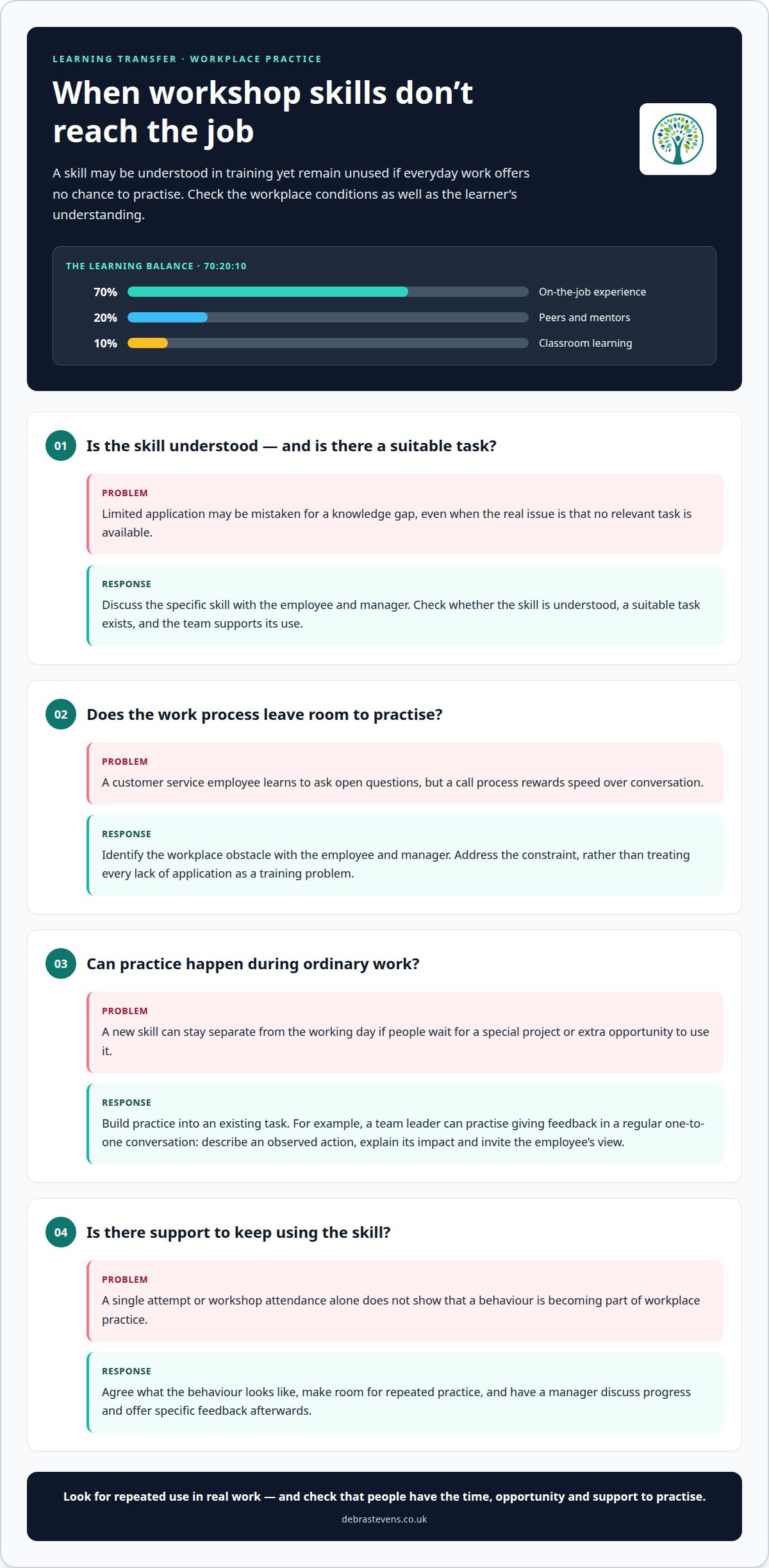
Classroom learning can change workplace behaviour, but attending a workshop alone won’t make new skills stick. The practical answer to how to transfer workshop learning to work is to connect learning with real tasks, give people chances to practise, and support them as they apply skills over time. The 70:20:10 methodology reflects this balance: 70% of learning comes from on-the-job experience, 20% from peers and mentors, and 10% from classroom learning.
It’s natural to expect a strong workshop to lead to confident, lasting change. Yet even useful ideas can fade when people return to roles where there’s little opportunity or encouragement to use them. The issue may not be ability: workplace conditions and chances to practise matter too.
This article explores whether classroom learning transfers, what evidence can show, and how managers and colleagues can create practical opportunities to apply new skills. You’ll also see how creative, realistic learning experiences can bridge the distance between the workshop and the working day.
Key Takeaways
- Make transfer part of a connected learning workflow, linking workshop goals to real work and ongoing support.
- Look for repeated use of skills in realistic tasks, not just confidence or a single successful attempt.
- Check whether people have the time, opportunity and manager support to practise before arranging more training.
- Use engaging, lifelike approaches to help participants rehearse workplace challenges and turn ideas into action.
Transfer of learning into the workplace – does classroom learning work?
Yes, classroom learning can influence workplace behaviour when employees can practise new skills and receive support after training. The 70:20:10 methodology places 10% of learning in classroom-based activity, with workplace experience and social learning supporting the wider process.
Workplace workflows and learning support
A learning workflow links workshop goals to relevant tasks, practice and follow-up at work. Before training, agree a suitable task with the participant and their manager, such as using a new questioning technique in a customer conversation. Afterwards, make room for that task in the employee’s workflow. This link matters: learning cannot shape behaviour if everyday demands leave no opportunity to use it.
Motivation and supportive work environments
Motivation is an employee’s willingness to use new knowledge; a supportive environment makes that effort possible. Blume and colleagues’ meta-analysis found positive relationships between training transfer, motivation and workplace support. Connect the skill to a meaningful challenge, career goal or sense of accomplishment. Then remove practical barriers, such as a process that prevents employees from trying a new approach. Engagement grows when people see a reason to act and have room to do so.
Colleague and leadership support
Colleague and leadership support reinforces learning through shared practice, clear expectations and feedback. Hughes and colleagues’ review found positive relationships between training sustainment and peer, supervisor and organisational support. A manager can demonstrate the expected behaviour, assign relevant work and discuss progress. Colleagues can form a small learning group, share examples and reflect on what helped. This makes practice a team activity rather than leaving each employee to apply new skills alone.
Applying learning before, during and after workshops
Participants can prepare by identifying a real work challenge, practise with questions and scenarios during training, then apply one specific skill afterwards. Comprehensive training providers such as Trainetics Academy structure their programmes around these distinct stages to help ensure classroom learning translates into genuine capability. An effective action plan names the skill, workplace task, support needed and follow-up discussion. A manager can review progress using examples from actual work, then agree another opportunity to practise. There’s no fixed transfer timeline: workplace performance develops through repeated use, feedback and access to relevant tasks, not attendance alone.
Evidence for transferring classroom learning into the workplace
Evidence of transfer comes from what employees do in real work, not attendance or course satisfaction alone. Measure whether they use a defined behaviour repeatedly. Then distinguish that change from learning gained in the workshop and wider organisational outcomes.
Facilitator explanations and workplace examples
A facilitator can connect a skill to the decisions and constraints employees face in their roles. For example, explaining active listening through a customer complaint helps participants understand when to use it, not just what it sounds like in theory. Add workplace examples, then invite participants to identify where the same strategy fits their responsibilities. This makes development relevant and gives employees a clearer reference point for practice.
Workplace scenarios and role-playing
Workplace scenarios recreate the choices, pressures and information people encounter on the job. A role-play about a challenging customer conversation lets participants practise a response, receive feedback and try again before using it at work. Research on a project-management simulation at Cranfield University examined 10 cohorts of master’s students. The study illustrates how structured simulations can make learning observable, while realistic tasks help reveal where participants need further practice.
Observable behaviours and workplace measurement
Observable behaviours are specific actions colleagues or managers can see, such as asking an open question before offering a solution. Employers can record examples during relevant work, using manager observations, work samples or participant reflection. Look for repeated use: one successful example is weaker evidence of developing practice. Keep learning, behaviour and organisational outcomes distinct, and consider workplace influences before linking wider results to a course.
For interpersonal skills, actor supported practice can create realistic conversations for participants to rehearse and refine.
Checking whether learners have opportunities to apply skills
A skill can be understood in a workshop yet remain unused if everyday work offers no chance to practise. Check the learner’s tasks, expectations and support before treating limited application as a training problem.
Barriers to applying learning
Barriers are workplace conditions that prevent employees using a skill, even when they understand it. A customer service employee may learn to ask open questions, then face a call process that rewards speed over conversation. Discuss the specific obstacle with the employee and manager: is the skill understood, is a suitable task available, and does the team support its use? This helps distinguish a knowledge gap from a lack of opportunity, so the response addresses the real constraint.
Using new skills in everyday work
Everyday application means using a workshop skill during a normal task, rather than waiting for a special project. A team leader practising feedback could use a regular one-to-one conversation to describe an observed action, explain its impact and invite the employee’s view. Agree what the behaviour looks like, then make room to practise within existing work. A manager can discuss progress and offer specific feedback afterwards. This helps employees improve performance without separating development from their responsibilities.
Applying learning in new contexts
Applying learning in a new context means adapting a familiar skill to different people, pressures or tasks. Someone who practises handling disagreement in a team meeting may need the same listening skills with a client. Identify what stays consistent, such as summarising the other person’s concern, and what changes, such as the conversation’s purpose. A short review after each new situation helps the employee notice what worked and adjust their approach. Support should fit the new task, rather than assuming the first practice suits every setting.
Creative approaches to transfer
Creative transfer turns a workshop idea into a memorable cue for action, not another document employees forget. A practical way to understand how to transfer workshop learning to work is to connect a useful principle with a prompt people can recall during a real task. For a team improving presentations, that prompt might be: “Make one point, give one example, invite a response.”
Make the cue tangible. Participants can create a mini storyboard showing how a difficult conversation might unfold, then identify where a new skill could change the outcome. A customer service team could map a complaint from opening to resolution, marking where listening, empathy and a clear next step matter. This turns theory into visible choices employees can adapt at work.
Build small experiments into existing routines. After a workshop, a manager might invite each employee to test one technique in a team meeting, then discuss what happened during a brief peer huddle. For teams considering how to transfer workshop learning to work, a prompt such as “What did you try, and what would you change?” makes reflection practical. Coaching can then focus on a real moment and refine the next action.
Creative methods work best when they support a clear behaviour, not novelty for its own sake. A visual reminder, story or practice challenge should point to an observable action, such as asking a colleague for their view before deciding. Teams can revisit the prompt after practice and adapt it to different situations, making successful application easier to notice and share.
For communication skills that need confident delivery in real meetings, explore Presentation Skills Coaching and turn workshop insights into stronger workplace presentations.
Debra Stevens Training and Coaching
Debra Stevens Training and Coaching helps organisations turn people skills development into practical workplace learning. Its experiential workshops use professional actors in realistic role-play, giving participants the chance to practise responses and explore how different approaches affect a situation.
Turn to this support when a workshop needs to reflect your organisation’s challenges or employees need skills for daily interactions. Conscious Human Skills Workshops and Leadership & Management Training connect learning with the conversations, decisions and behaviours employees encounter at work. Customer Service Excellence can also help teams strengthen customer interactions.
Share your learning goals and workplace context, then explore an approach shaped around what your people need to practise. Contact Debra Stevens Training and Coaching to discuss your organisation’s learning needs.
Make the next learning opportunity count
Make your next development decision a workplace decision too. Before planning another workshop, identify the moment when employees need to act differently, then shape practice around that reality. Knowing how to transfer workshop learning to work starts with choosing a meaningful behaviour and creating space to use it. This gives managers and learners a shared direction, while leaving room to adapt as work changes.
Debra Stevens Training and Coaching can help organisations connect people development with practical workplace challenges through The Why Factor, Conscious Human Skills Workshops and Leadership & Management Training. If you’re ready to explore an approach that fits your team’s needs, contact Debra Stevens Training and Coaching to start a conversation. A thoughtful next step can turn learning into progress your people can build on.
Frequently Asked Questions
What should you do if people aren’t applying their training?
Find out whether the issue is skill, opportunity or workplace process before arranging more training. Ask an employee to explain the technique, then use a short practice scenario to see whether they can demonstrate it. If they can, examine what blocks its use. For example, a customer service script may leave no room for the listening approach taught in a workshop.
What is learning transfer from workshops to the workplace?
Learning transfer means using knowledge or skills from a learning experience in a different setting, such as applying a workshop technique in a real meeting. It involves more than recalling an idea: the learner adapts it to the task and puts it into practice. For example, someone on a presentation course might use a message-structuring technique when briefing colleagues.
How can managers support transfer of training after a workshop?
Managers can make the expected change visible in everyday routines. At the next team meeting, invite an employee to lead a discussion using a workshop technique, then ask what felt different. Recognise a specific behaviour, such as inviting quieter colleagues to contribute, and agree where it could be used again. This gives the learner a practical route from intention to continued use.
How can organisations create opportunities to practise new skills at work?
Build practice into existing responsibilities rather than relying on extra projects. An organisation developing presentation skills could let employees deliver a short update during a regular team meeting, then offer focused feedback. For negotiation skills, a manager might assign an appropriate supplier discussion with preparation support. Match the task to the learner’s responsibilities and give them the authority to use the skill.
How do coaching, peer support and feedback improve learning transfer?
Coaching helps learners examine a specific work situation and choose a useful next action. A colleague can offer another perspective, such as noticing whether a question helped clarify a customer’s concern. Keep feedback tied to observable actions and invite the learner to reflect before offering suggestions. This turns a difficult interaction into an opportunity to adjust, rather than a judgement about the person.
What are common barriers to transferring workshop learning and how can they be overcome?
Common barriers include competing priorities, unclear expectations, limited access to relevant tasks and workplace habits that reward different behaviours. Identify the exact point of friction: a new handover approach, for instance, may fail if the team’s form has no space for the required information. Adjust the process, clarify expectations with the manager and give employees a realistic chance to use the skill.






One Comment