

You’re presenting to a room that seems engaged. Then, afterwards, someone asks about a detail you mentioned, while your main point has slipped by. It’s a familiar frustration. Presentation skills coaching can help you shape what you want people to hear, without giving you a script to memorise.
You may already know that one course won’t make every presentation effortless. The useful part is learning how to keep practising, notice what’s working and adjust for the next audience. After 26 years in training, I’ve seen how much difference that thoughtful practice can make.
Coaching can help you organise key messages, adapt your approach for different audiences and practise with constructive feedback. It can also give you a way to keep improving after a session, so each presentation becomes an opportunity to learn, not just another date in the diary.
Key Takeaways
- Build confidence by noticing what triggers your nerves, practising in realistic situations and reflecting on what helps you feel prepared.
- Adapt your message and examples to the audience, and practise responding to questions with curiosity rather than rushing to answer.
- Shape your presentation around one clear key message, so each section supports the point you want people to remember.
- Use specific feedback to refine your delivery, then practise again and carry one learning point into your next presentation.
How can presentation skills coaching help you keep improving after a course?
A training session gives you space to practise, but your next presentation brings fresh demands. Keep developing through a simple cycle: notice, practise, reflect, then try again.
Managing Nerves and Building Confidence
Nerves often rise around a particular moment, such as the opening line or a senior colleague’s question. Name that moment and practise it separately: deliver your first sentence, pause, then begin again. This gives you a specific action to work on instead of a vague goal to “feel confident”. After each attempt, note one thing that felt steadier and one thing to adjust.
As you compare coaching and courses, look for practice time, actionable feedback and opportunities to try again. A useful programme connects its exercises to your presentations, audience and development needs.
Employers can fund coaching through workplace training budgets when it supports an agreed development need. A clear example, such as presenting project updates to clients, helps show how the training relates to your role.
Possible areas to develop include clearer delivery, confidence when speaking in public and greater awareness of body language. You can learn to notice how your pace, posture and language affect the message you want to get across.
Handling Questions and Negative Mindsets
An unexpected question can unsettle even a well-prepared speaker. Practise a short response sequence: pause, listen to the full question, clarify the point if needed, then answer directly. If you don’t know the answer, explain what you can and say what you’ll follow up. Rehearsing this exchange helps you respond thoughtfully instead of rushing to fill the silence.
If you’re choosing presentation skills coaching in the UK, look for relevant experience and a practical approach to feedback. Consider how the sessions will address your nerves, audience questions and real presentation examples, rather than relying on theory alone.
Negative thoughts can also narrow your focus, turning “I might stumble” into “I’ll fail”. Treat that thought as a cue to practise one section aloud, then reflect on what happened. Small, repeated attempts give you clearer evidence about what to keep and what to change.
How does a presentation skills coach adapt a presentation for different audiences?
A presentation that works for a project team may not land with people making strategic decisions. I help you tailor the emphasis and delivery to the audience in front of you.
Structuring Presentations Around Audience Needs
I begin by exploring what your audience already knows and needs from your presentation. A technical team, for example, may want to understand how a proposed change works, while department heads may need to know its implications for priorities. I help you choose the right starting point and decide which details deserve attention, so the talk feels relevant rather than simply comprehensive.
I also help you adapt the same core material for different audiences. A staff briefing might focus on how a decision affects daily work, while a meeting with external partners may need more context about the reasons behind it. We shift the emphasis without losing the central point or making it sound as though you’ve prepared an entirely different message.
Engaging and Holding Audience Attention
I help you invite people into the subject rather than asking them to listen passively. A short question, a relevant example or a change of pace can bring attention back to a key idea. We’ll choose an approach that suits your style and the setting, whether you’re presenting around a table or addressing a larger group.
I can also help you prepare for a room that challenges your assumptions. If someone questions a recommendation, acknowledge the concern and respond to what they’ve actually asked. If an interruption takes you off track, pause and reconnect your answer to the purpose of the talk. You can explore practical presentation practice that gives you space to work on these moments.
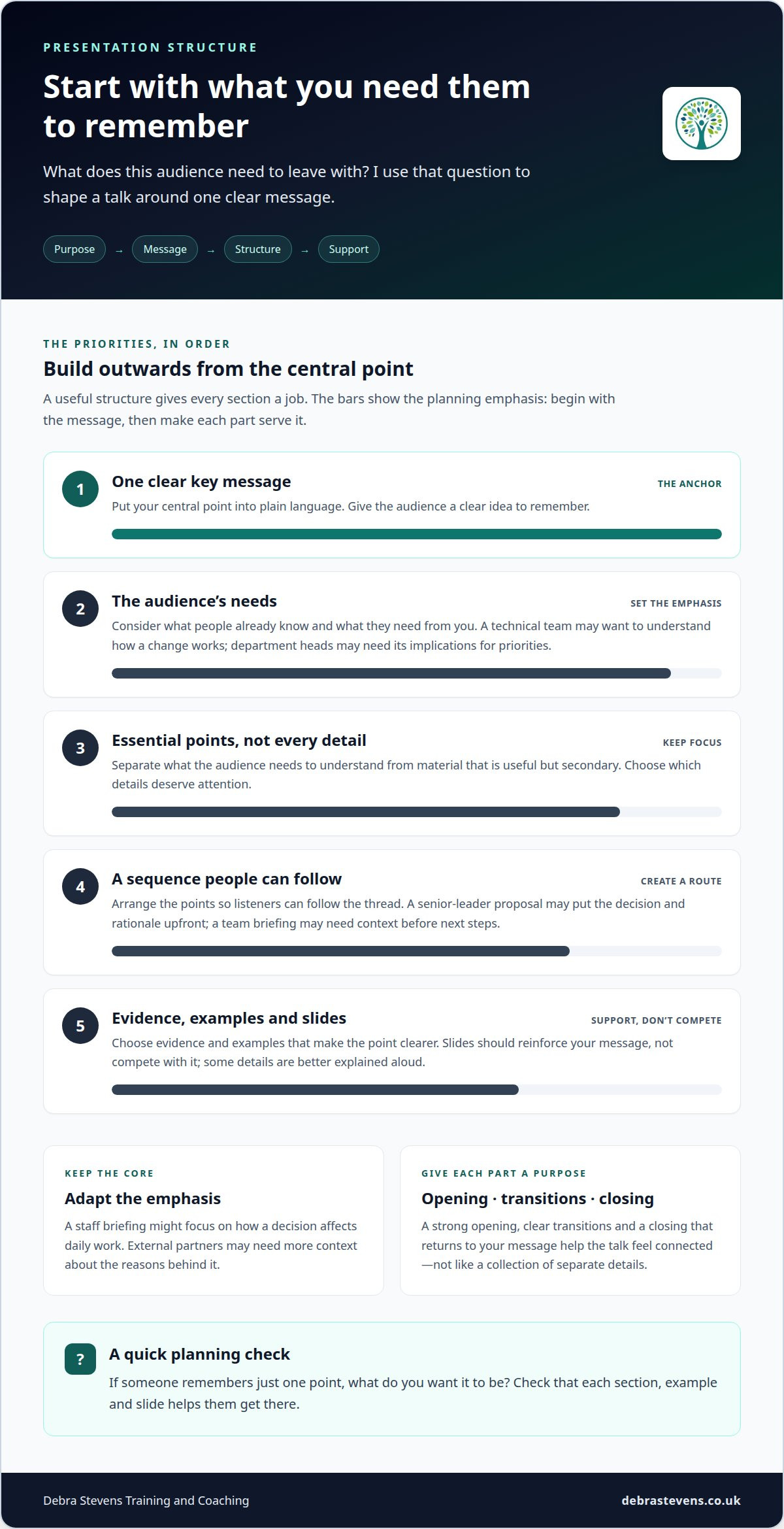
Structuring material and communicating key messages
A strong presentation gives your audience a clear route through complex material. I help you identify the central message, then build the structure around it.
Planning and Structuring Presentations
First, we look at your purpose, audience and material. A proposal to senior leaders, for example, may need the decision and its rationale upfront; a team briefing may need context before the next steps. I help you separate essential points from useful but secondary detail, then arrange them in a sequence listeners can follow. Bring the format and purpose into the planning conversation.
Scripting and Storytelling
A script can support your preparation, but memorising every sentence can make delivery sound fixed. I help you shape a strong opening, clear transitions and a closing that returns to your message. A short workplace example can make an abstract idea easier to understand. In presentation skills training, storytelling works best when it serves the point, rather than becoming a detour.
Shaping Persuasive Key Messages
Persuasion starts with a message your audience can grasp and act on. I help you express your main point in plain language, then select evidence and examples to support it. A proposal to change a process, for instance, should explain what needs to change, why it matters and what decision you’re seeking. This tailored structure gives each section a clear purpose.
A useful programme also considers how to present similar material in different settings. I can help you prepare one core message, then adjust the emphasis for a client meeting, team update or senior review. Slides should reinforce that message, not compete with it. We can identify crowded pages, repeated points and details better explained aloud, so the presentation stays focused and the audience can follow the thread.
Individual presentation practice and coaching feedback
I focus practice on the presentation you need to deliver, not abstract exercises. We start with a specific goal, then use feedback to decide what to try next.
Guided Practice and Rehearsal
I shape rehearsal around your task, whether you’re presenting a proposal or explaining a difficult change. We can focus on the opening, transitions or a moment you find demanding, then practise it again with a clear adjustment. Realistic workplace scenarios can help you rehearse responding when a listener challenges your point. A professional business actor can play that person, contribute to the feedback, and help you try the conversation again.
Is one-to-one coaching better than group presentation training? Individual coaching gives close attention to your needs; group practice lets you learn by observing others. The right format depends on whether you need personal focus or shared practice.
Personal Feedback and Video Review
In the programme described in the course information, participants deliver two formal presentations on video and receive one-to-one coaching after each. I use feedback to help you notice a specific delivery habit, such as rushing through a key point or losing eye contact. We can then choose one change and try the presentation again, making the feedback practical rather than overwhelming.
A session with me can begin with your goal, move into presentation practice, then use feedback to guide another attempt. For example, I might ask you to pause after a key point and notice how that changes your pace. The focus stays on techniques you can use in your own work.
How many sessions are typically needed? I shape the programme around your aims, the complexity of your presentations and the practice you need. We can discuss an approach that suits your situation.
If you’re ready to work on a presentation with personal feedback, discuss presentation coaching.
Debra Stevens Training and Coaching: Presentation Skills Coaching
Debra Stevens Training and Coaching offers tailored support for professionals who want to shape a clear message, adapt their delivery and practise for important presentations. I build the work around your role, audience and development goals, so sessions focus on situations you need to handle.
My approach is practical and actor-supported. Through presentation skills coaching, you can practise realistic workplace scenarios, receive immediate feedback and try again with a specific adjustment in mind. That might mean refining a presentation for senior colleagues or responding clearly to a challenging question.
If you’re looking for presentation skills coaching that connects preparation with realistic practice, you’re welcome to discuss your training brief with me or join a free live training session.
Make your next presentation a starting point
Your next presentation doesn’t need to be perfect. It can be a chance to notice what connects with your audience and choose one thing to develop for next time. That’s how presentation skills coaching becomes part of your working practice, rather than something you complete and leave behind.
If your goals extend beyond presenting, I also offer The Why Factor, Conscious Human Skills Workshops and Leadership & Management Training. Each can support a different area of your professional development, depending on what you want to work on.
Perhaps you’re preparing for a high-stakes presentation, or you’d like to help your team communicate with greater clarity. Start with the situation you want to handle and the change you’d like to make. You can find out more about Debra Stevens Training and Coaching as you consider your next step. One thoughtful next step can make your next presentation a useful opportunity to practise.
Frequently Asked Questions
Do you offer public presentation courses?
I don’t run public open-enrolment courses. Instead, I work with professionals and organisations on presentation skills through tailored coaching and training. We can focus on a specific work situation, such as explaining a proposal to colleagues or speaking at a client meeting. I shape the work around what you need to communicate and the audience you need to reach.
Where are the courses held?
I deliver sessions in-house or virtually, including through Zoom. For in-house work, we can use examples drawn from your organisation’s context. Virtual sessions offer another way to take part. I’ll discuss the training’s purpose and your preferred format, then tailor the delivery to the work and the people involved.
Do you provide any accreditation or certification?
I provide practical development rather than an accredited qualification. The focus is on communication skills you can apply in presentations, such as explaining a proposal or speaking to colleagues. If you need a formal qualification for a particular role, my coaching isn’t a substitute for that credential. I can help you decide whether practical skills development matches your current aim.
Does it run online?
Yes, I deliver sessions virtually, including through Zoom. I tailor the online format to your development goals and the presentations you need to give. For example, we can work on using the camera and addressing remote listeners, or on sharing material clearly on screen. Tell me about your online presentation, and I’ll focus the session accordingly.
How can a coach prepare you to handle awkward questions or interruptions?
I can help you prepare a simple response plan for situations that might unsettle you. We can identify difficult questions, decide what you need to clarify before answering and practise a concise response. I’ll also help you consider how to respond if someone raises a point outside your presentation’s scope, so you can acknowledge it without losing focus.
How can a presentation skills coach help you make your slides support rather than distract your audience?
I can review the order and purpose of your slides with you. For each one, we can identify the idea you want the audience to take away and whether the slide helps make that idea clear. We can also plan when to reveal information, particularly if you want listeners to consider a question before seeing your recommendation. If you’d like to talk through your presentation, I’d be glad to hear about it.






One Comment