

What if confidence isn’t about feeling fearless, but knowing where to focus when nerves arrive? If you’re wondering how to become a more confident presenter, start by thinking less about how you look and more about what your audience needs from you.
It’s understandable to think confidence comes from perfecting every word. Preparation matters, but so does making a genuine connection. A clear purpose gives you something to return to, practice helps you find your footing, and letting your personality come through makes your message feel human.
Here are four practical ways to build confidence: connect with your audience, prepare with purpose, practise before it counts, and communicate in a way that feels authentic to you. Try one small change in your next presentation, then notice how it lands.
Key Takeaways
- Before you speak, ask yourself what you want your audience to understand. Then pay attention to how they react as you talk.
- Let your personality come through in a clear, natural delivery. You’ll make it easier for your audience to connect with you and your message.
- Try a brief outline and rehearse your opening. That gives you a steady starting point without asking you to memorise every word.
- Choose one communication value, such as listening or empathy, to guide how you speak and respond.
1. Focusing attention on purpose and audience connection
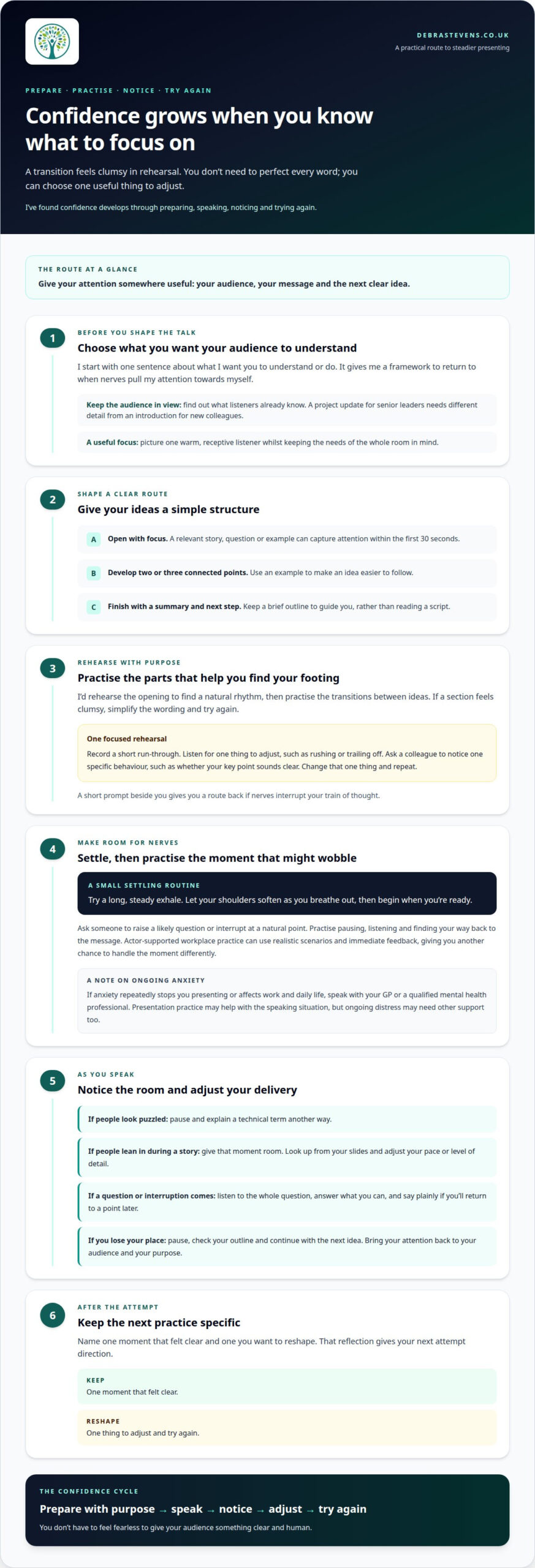
Before I shape a talk, I write one sentence about what I want you to understand or do. I use it as my framework when nerves draw my attention towards myself. I might picture one warm, receptive listener and speak to that person while keeping the needs of the whole room in mind. A project update for senior leaders needs different detail from an introduction for new colleagues, so I find out what listeners already know.
How do I structure a clear and engaging presentation? I begin with a focused opening, develop two or three connected points, then finish with a summary and next step. A relevant story, question or example can help capture your attention within the first 30 seconds. For instance, I might put a sales figure into context through a customer’s experience, then explain the decision it supports. I keep a brief outline to guide me without reading a script.
As I speak, I notice how the audience responds. If people look puzzled after a technical term, I pause and explain it another way. If they lean in during a story, I give that moment room. I look up from my slides and adjust my pace or level of detail to help you follow. I treat the presentation as a conversation, even when I’m the only one speaking.
Questions can bring you into the conversation. I ask one focused question, explain how to respond, then briefly comment on what I hear. For example, I might invite a show of hands about the most pressing project risk, then connect the response to my recommendation. I use questions to find out what matters to you, not simply to interrupt my message.
How do I handle questions, interruptions and mistakes during a presentation? I listen to the whole question, answer what I can, and say plainly if I’ll return to a point later. If I lose my place, I pause, check my outline and continue with the next idea. After a stumble, I bring my attention back to you and my purpose.
2. How do I gain public speaking confidence?
I’ve seen people wait to feel confident before they speak. In my experience, confidence grows through action, not by waiting to feel ready. Your heart may pound before a presentation, but that doesn’t mean you’ll perform badly. Try reframing the energy by telling yourself, “I’m excited to share this.” Then focus on the idea you want people to understand, rather than judging every movement or word.
I’d prepare enough to feel grounded, but I wouldn’t memorise every sentence. Rehearse the opening to find a natural speaking rhythm, and practise the transitions between ideas. If a section feels clumsy, simplify the wording and try again. Keep a short prompt beside you instead of a script to read aloud. It gives you a route back if nerves interrupt your train of thought.
I encourage you to use practice to make the experience more familiar. Record a short rehearsal, then listen for one thing to adjust, such as rushing or trailing off. Ask a colleague to notice one specific behaviour, such as whether your key point sounds clear. Change that one thing and repeat the presentation. Focused feedback gives you a practical next step, rather than a vague judgement about how you came across.
I believe your speaking style feels more credible when it sounds like you. If you naturally use a simple example to explain a complex idea, keep it. If a pause helps you think, let the silence do its job. Use your hands to support a point, not to fill every moment. For instance, describe a decision you’ve made, explain what you learned, then connect it to your message. That personal detail can make your expertise easier to trust without turning your talk into a performance.
After your next practice, I’d like you to name one moment that felt clear and one you want to reshape. That reflection gives your next attempt direction. I’ve found confidence develops through preparing, speaking, noticing and trying again, not through perfect delivery.
3. Managing presentation nerves through preparation and practice
Preparation helps when it gives your attention somewhere useful to go. Write your central message, then map the route from opening to close. Rehearse the transitions between ideas rather than polishing every sentence. Picture the room and mentally walk through the start of the talk. That simple run-through can make the first moment feel less unfamiliar.
Before speaking, try a long, steady exhale. Let your shoulders soften as you breathe out, then begin when you’re ready. You could sit quietly for a few minutes or move gently if stillness makes you restless. Keep the routine simple. It’s there to help you settle, not become another task to get perfect.
Practise in a supportive setting with someone who can listen without taking over. Ask them to raise a likely question or interrupt at a natural point. Then practise pausing, listening and finding your way back to the message. Actor-supported workplace practice can use realistic scenarios and immediate feedback to give you another chance to handle the moment differently.
Give each rehearsal a clear purpose. Use one run to check the sequence, then another to notice where you rush or lose emphasis. A voice recording can reveal phrases that are hard to follow. Choose one adjustment, such as slowing down before a key point, and practise that section again. Stop when further rehearsal only polishes words rather than improving clarity.
If anxiety repeatedly stops you presenting or affects work and daily life, speak with your GP or a qualified mental health professional. Presentation practice can help you work on the speaking situation, but ongoing distress may need other support too. Notice what feels manageable and choose a next step that fits.
4. Authenticity and communicator values
A confident presenter doesn’t need to act like someone else. You can adapt your style to the room while keeping the values that make your communication genuine. A formal project update can still sound like you: explain the decision plainly, acknowledge what’s uncertain, and show why it matters. That balance helps your audience focus on the message, not a performance.
Try the D.I.V.A. framework: dynamic, inspiring, valuable and authentic. Use it as a quick check, not a script. Does your opening create interest? Does your example show why the subject matters? Does each point offer something useful? And does the way you deliver it fit your values? A detailed presentation can be dynamic through a clear story, not louder gestures or extra slides.
Choose one communication value to guide your next talk. If yours is empathy, explain how a proposed change affects the people doing the work. If it’s clarity, replace a string of technical terms with one plain-language example. The Stand Out framework offers another useful route: Engage, Listen, Empathise, Collaborate, Inspire. Pick the element that fits your purpose, then let it shape how you respond to the audience.
When nerves appear, return to that value. If you lose your place, pause and ask what your listeners need next. If a question challenges your idea, listen fully before answering. You don’t have to sound flawless to be credible; a thoughtful response can show your values more clearly than a polished line. After practising, ask yourself: “Did my message sound like me, and did it serve the audience?”
If you’d like a structured space to practise a more authentic speaking style, explore practical communication support. Choose one value for your next presentation, and notice how it shapes your words.
Debra Stevens Training and Coaching
I help you build confidence by practising communication in realistic workplace situations. I focus on what happens in the room: how you begin, explain your message and respond when the conversation shifts.
In my experiential workshops, you can practise, notice how your words land, receive feedback and try again. Professional actors can create realistic scenarios, giving you space to work through difficult moments before they count. The aim is practical learning, not performing a perfect speech.
If nerves, unclear messaging or audience reactions are getting in the way, supported practice can give you a useful next step. Explore Conscious Human Skills Workshops to strengthen the communication habits that support confident presenting.
To discuss what would help you or your team, contact me.
Take your next speaking step
Your next presentation is a chance to test one small change, not prove you’ve mastered everything. Choose a real meeting, briefing or team update, then decide what you want people to think, feel or do afterwards. That intention gives your preparation direction and makes progress easier to notice.
If you’re still asking how to become a more confident presenter, let curiosity lead: what would you like to handle differently next time? Turn your answer into one practical focus. For wider communication and leadership development, The Why Factor and Leadership & Management Training may also be relevant.
You don’t need to wait until you feel completely ready. Take the next opportunity to speak, notice what happens, and give yourself something specific to practise. If you’d like to discuss a training brief, contact Debra Stevens Training and Coaching. I’d be glad to hear what you’re working towards.
Frequently Asked Questions
How do I gain public speaking confidence?
I’d build confidence by collecting evidence of what works for you. After each presentation, write down one moment that went well and why. Perhaps a clear example helped colleagues understand a proposal, or a question revealed what they needed. Use that observation in your next talk. In my experience, confidence grows through practice; it’s not a feeling you have to wait for before speaking.
What practical steps help build confidence before a presentation?
I suggest reducing avoidable surprises by checking practical details before your talk. Confirm the room, screen arrangement and how you’ll share slides. Save a copy of your presentation somewhere you can access if your usual device fails. If someone is hosting, agree how they’ll introduce you and signal the end of your slot. Then have your materials ready so you can focus on the audience.
How can I reduce presentation anxiety and nerves?
I find it helps to distinguish between what you can control and what you can’t. You can clarify your opening, check your equipment and decide how you’ll respond if a question catches you off guard. You can’t control every audience reaction. Before speaking, name the worry plainly, then choose one useful action. For example, if you fear losing your place, mark the key transition in your notes.
How can I practise a presentation effectively and how often?
I’d practise often enough to speak from a clear understanding, not a memorised script. Set the frequency according to the talk’s complexity and your familiarity with the subject. Use one run to check the main message, then another to practise likely questions or interruptions. Finish when further rehearsal only polishes words rather than improving clarity. If the content changes, practise the revised sections before presenting.
What body language and voice techniques make a presenter seem confident?
I’d use a voice people can follow: finish your sentences, pronounce key terms clearly and vary your emphasis to show which ideas matter. Avoid rushing through the final words of a point. Keep gestures purposeful, such as using an open hand to invite discussion instead of fidgeting with a pen. These choices can help your delivery feel composed while keeping attention on what you’re saying. If you’d like to practise before it counts, you’re welcome to join one of my free live training sessions.






One Comment