

Difficult conversations rarely stay focused on the issue alone. People can make assumptions, hide feelings or react defensively, while unclear expectations and different viewpoints make feedback harder to give and receive. Leadership training for difficult conversations helps leaders prepare, communicate clearly and stay grounded when emotions rise.
If you put off feedback, worry about someone’s response or soften a message until it loses its meaning, you’re not alone. Difficult conversations require you to balance honesty with respect, set clear boundaries and uphold accountability without shutting down discussion.
This article explains why these conversations can feel challenging and how practical skills can help. You’ll find ways to prepare, communicate feedback clearly, listen to different perspectives and agree a constructive next step, even when you disagree.
Key Takeaways
- Prepare with a clear purpose, specific examples and a calm, private setting so the conversation can stay focused.
- Give feedback directly and respectfully, making expectations and boundaries clear while keeping the discussion open.
- Use questions and reflective listening to understand another viewpoint before working towards a constructive way forward.
- Practise challenging conversations to build confidence, manage emotional reactions and strengthen accountability.
Why is Having Difficult Conversations, Well, Difficult?
A challenging conversation can feel personal, even when the issue is a missed deadline or unclear responsibility. People may form a view before hearing the other person’s account, while strong feelings can lead leaders to avoid the message or say something they later regret. Start by separating observable behaviour from assumptions about someone’s character.
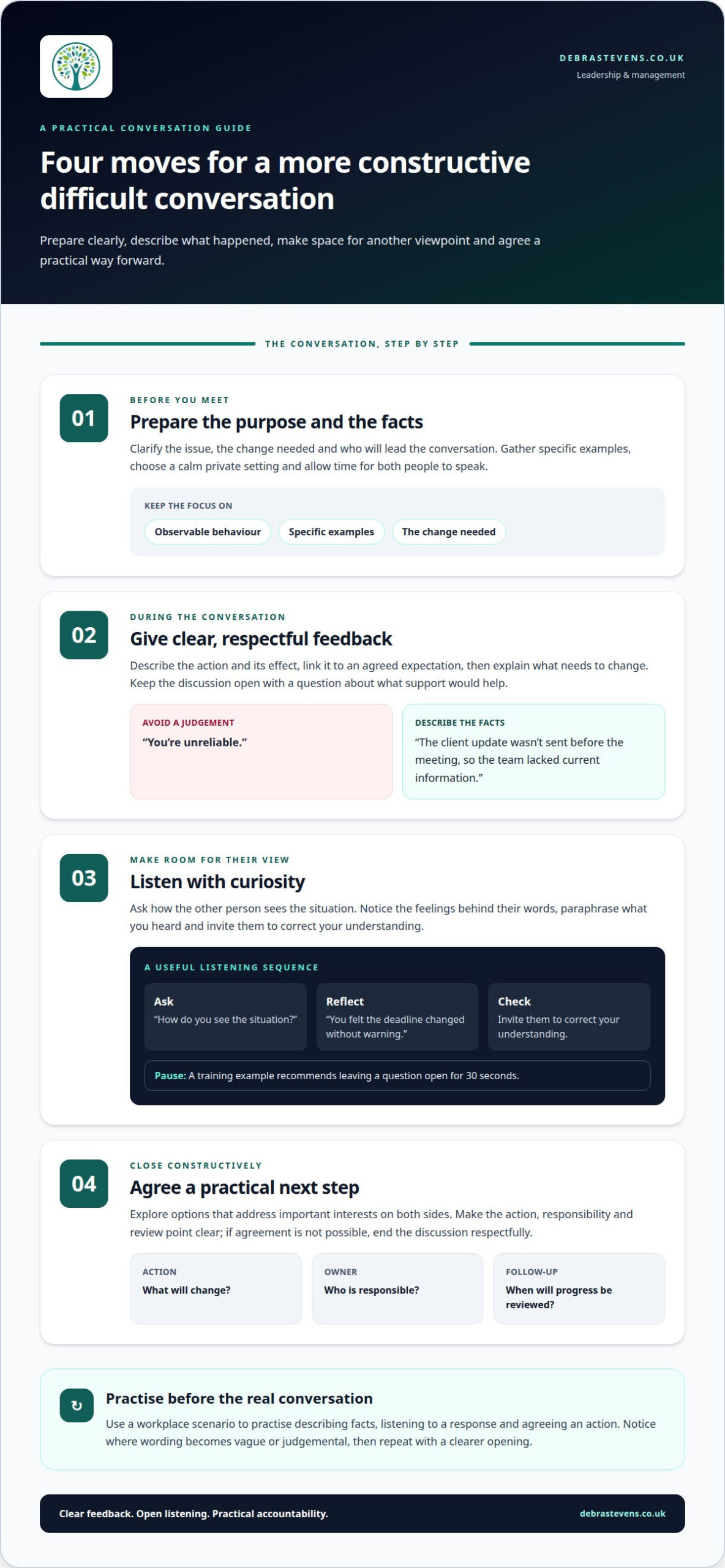
For a high-stakes workplace conversation, clarify its purpose, the issue and who will lead it. Gather specific examples, such as agreed tasks that were not completed, and identify the change needed. Arrange a private meeting with enough time for both people to speak. Preparation helps you understand the situation without turning the discussion into a case against someone.
An informal conversation needs a lighter structure, not less thought. Before approaching a colleague about repeated interruptions, decide what outcome you want and consider your own feelings. Choose a suitable moment, describe what you observed and invite their perspective. A calm opening can build understanding before a small problem affects working relationships.
Plan for a win-win outcome by identifying the important interests on both sides. A manager may need reliable handovers, while an employee needs realistic deadlines. Explore options that address both concerns. If agreement is not possible, aim to end the discussion respectfully. This keeps disagreement focused on practical outcomes rather than winning an argument.
Difficult-conversation training develops a leader’s ability to give direct feedback, set boundaries and uphold accountability. Conflict management training can address a wider range of disagreements, while mediation training focuses on helping parties work through a dispute, often with an impartial facilitator. For one-to-one guidance, executive coaching from specialists such as Simon Lead LLC can also help senior managers strengthen their leadership capabilities and navigate sensitive workplace dialogues. Choose training to match the situation and the role you need to play.
In the UK, workplace conversations should follow relevant organisational policies and processes. Where an issue could lead to disciplinary action, Acas advises employers to consider whether it can first be resolved informally. Formal discussions should explain the issue, give examples and allow a two-way response.
Avoidance can deepen confusion or tension, while a poorly handled conversation can damage trust and leave expectations unresolved. Review training impact by checking whether managers prepare clear examples, invite employee perspectives and agree practical next steps. Follow-up conversations can show whether these behaviours are becoming part of everyday practice.
Feedback, boundaries and accountability
Feedback can support progress when it identifies behaviour and its effect. A missed handover, for example, gives a leader a specific starting point for discussion.
Build the conversation around observable actions, clear expectations and a practical next step. How a leader responds to feelings matters, too.
Building psychological safety through feedback
Psychological safety grows when people can raise concerns without being dismissed or personally blamed. If an employee says a handover failed because priorities changed, the manager can acknowledge that context and still explore what needs to improve. Notice whether feedback invites an honest response rather than simply delivering a verdict. This balance can build confidence and help resolve problems earlier.
Giving clear feedback
Keep feedback specific, factual and linked to an agreed expectation. Instead of saying, “You’re unreliable,” a manager might explain, “The client update wasn’t sent before the meeting, so the team lacked current information.” Then describe the required change and ask what support would help. Clear examples reduce ambiguity, while a coaching question gives the employee space to respond and take ownership.
Setting boundaries and accountability
A boundary explains what must change and why; accountability makes the next step clear. For repeated interruptions, a leader could say that colleagues need to finish speaking, explain how interruptions affect meetings, and agree how to address them. Record the action, who is responsible and when progress will be reviewed. If the behaviour continues, refer to the agreement and discuss the impact directly.
Practising feedback
Practice lets managers test their wording before a real workplace conversation. Use a scenario such as an employee reacting defensively to feedback about missed deadlines. One person practises describing the facts, listening to the response and agreeing an action; an observer notes where language becomes vague or judgemental. Repeat the role-play with a clearer opening. For more confident delivery, explore Presentation Skills Coaching.
Listening to and exploring different viewpoints
Conflict can reveal different priorities, not just a problem to eliminate. Listen first, then decide how to move the discussion forward.
Listening with curiosity and empathy
Start by asking how the other person sees the situation. If a colleague missed a deadline, ask what affected their progress before explaining your view. Notice the feelings behind their words, then paraphrase what you heard: “You felt the deadline changed without warning.” Invite them to correct your understanding. This approach helps both people discuss the issue without treating one account as the only valid one.
Using the ‘yes and…’ approach
“Yes, and…” acknowledges a point before adding another perspective. A manager might say, “Yes, the team had competing priorities, and we still need a reliable handover.” This keeps discussion open without requiring agreement on every detail. Don’t use the phrase to disguise a rebuttal. First show that you understand the concern, then add information or explore an option that could address both needs.
Using silence and active listening
After asking a genuine question, pause instead of answering it yourself. In a training example, Dan Boniface recommends leaving a question open for 30 seconds. That space can help an employee consider what happened and what could improve. Keep your attention on their response, avoid interrupting, and reflect key points back. For example, “You’re saying the handover notes were incomplete.” Then check whether you understood correctly.
When viewpoints remain far apart, separate shared facts from interpretations. A team member may see a change as unfair, while a manager sees it as necessary for customers. Acknowledge both accounts, ask what each person needs next and identify one practical step to try. Organisations can make better use of conflict when people question assumptions, explain their reasoning and keep communication open.
Conversation skills training for leaders
Useful training turns principles into behaviours leaders can apply in real conversations. A manager might practise opening a performance discussion, responding to defensiveness and agreeing a next step. The aim isn’t a perfect script. It’s the confidence to listen, manage intent and adapt communication as the conversation develops.
The best leadership courses for difficult conversations in the UK build practical skills, not just knowledge. Look for a clear framework, realistic workplace scenarios, guided practice and feedback on what to improve. A course should help an executive or team leader handle feedback, boundaries and disagreement in ways that fit their organisation’s culture.
Check how participants practise. In a role-play about missed deadlines, one person can practise describing the impact, asking for the employee’s perspective and agreeing an action. A facilitator or observer can then point out specific behaviours, such as interrupting or using judgemental language. Repeating the scenario with revised wording helps turn feedback into a skill.
Online and in-person training can both support leadership development in the UK. Online sessions can suit distributed teams, whilst in-person practice allows participants to work through scenarios together. The useful comparison is how each format makes room for interaction, rehearsal and feedback, rather than the format alone.
Before choosing training, identify the conversations managers find hardest. A team facing recurring handover problems, for example, may need to practise setting expectations and addressing missed commitments. Consider whether the content reflects your workplace, whether participants can practise challenging behaviour and how they will apply the learning in daily conversations.
Strong training also explores what happens after a conversation. Managers can review whether the agreed action was clear, whether both perspectives were heard and what they would adjust next time. That follow-through helps organisations connect individual communication skills with a more open culture. Build those skills through leadership development training.
Debra Stevens Training and Coaching: Leadership & Management Training
Debra Stevens Training and Coaching develops leaders’ practical skills in feedback, boundaries and accountability through Leadership & Management Training. Its experiential workshops use realistic role-play scenarios with professional actors, giving managers space to practise difficult conversations and reflect on their approach.
Turn to this training when leaders need more than a framework, for example, when feedback feels uncomfortable or expectations are not being addressed clearly. Programmes are tailored to organisational requirements, so participants can work with relevant situations and develop communication that supports stronger working relationships. The Why Factor and Conscious Human Skills Workshops can also help participants reflect on the human dynamics behind workplace conversations.
Contact Debra Stevens Training and Coaching to discuss your leadership development needs.
Make your next conversation a turning point
Your next difficult conversation can shape how your team works together. Choose one situation you’ve been avoiding and decide what constructive progress would look like. A clear intention gives you a practical starting point, even though you can’t control the other person’s response.
Leadership training for difficult conversations can help managers turn that intention into confident, considered action. Debra Stevens Training and Coaching offers Leadership & Management Training, The Why Factor and Conscious Human Skills Workshops to support leadership and communication development. These offerings can help organisations build the human skills behind everyday workplace conversations.
Ready to develop your managers’ confidence? Contact Debra Stevens Training and Coaching to discuss your organisation’s needs. A thoughtful next conversation can begin with one clear step.
Frequently Asked Questions
How do I know this won’t be ‘fluffy’ coaching?
Look for practical rehearsal, specific feedback and skills managers can apply at work. In an experiential workshop, participants might practise addressing a missed client commitment, then reflect on their wording and response. Debra Stevens Training and Coaching uses interactive learning methods, so development centres on trying different approaches and building awareness, rather than listening to abstract advice alone.
Is this training for individuals, teams, or both?
This training can support individual development and teams working through shared communication challenges. A manager might focus on confidence in addressing underperformance, while a team could explore how colleagues raise concerns across roles. Debra Stevens Training and Coaching tailors programmes to organisational requirements, allowing learning to focus on the people involved and the workplace situations they need to handle.
What if the other person gets emotional or defensive?
Stay steady, acknowledge the reaction and avoid arguing about feelings. If an employee says, “You’re blaming me,” you could respond, “I can hear this feels unfair. Let’s look at the specific decision and its impact.” Pause before continuing, then ask what they think happened. If the discussion becomes unproductive, agree to return to it when both people can engage constructively.
What does leadership training for difficult conversations cover?
This training develops practical ways to address sensitive workplace issues, including missed expectations, performance concerns and disagreement. Participants can practise opening a conversation clearly, responding to challenging reactions and agreeing next steps. The focus is on applying communication skills to realistic situations, so leaders can adapt their approach to the issue, the relationship and the change needed.
What skills do leaders need to handle difficult conversations effectively?
Leaders need clear communication, active listening, emotional self-management and the ability to ask open questions. They also need to distinguish facts from assumptions. For instance, “The report arrived after the agreed deadline” describes an event; “You don’t care about the project” judges someone’s intent. Combining specific observations with curiosity keeps discussion focused on behaviour and improvement.
What steps should a leader follow to prepare for a difficult conversation?
First, identify the issue and the change you need to discuss. Gather relevant examples, decide what outcome would be useful and consider what the other person may want to explain. Choose a private setting and a suitable time. Plan a concise opening, but leave room for their perspective. Close by agreeing actions, who owns them and how you’ll review progress.






One Comment