Better workplace communication is built through practice, not another email rule. To learn how to build better communication at work, help people listen without interrupting, make messages clear and choose a channel that suits the conversation. Then give teams opportunities to practise those skills together.
Quick messages and regular meetings have their place, but communication improves when people understand one another, not simply exchange information. Active listening, clear messages and thoughtful feedback help colleagues work through misunderstandings and agree what happens next.
These practical approaches can strengthen communication across teams, from adapting messages to the audience to building shared skills through coaching and workshops. Employees and employers can both contribute, while realistic role-play gives people a chance to practise new approaches.
Key Takeaways
- Listen without interrupting, ask clarifying questions and summarise key points to check you’ve understood.
- Choose a communication channel to suit the urgency, complexity and sensitivity of the message.
- Make work messages concise and easy to act on by stating the required action and deadline clearly.
- Practise specific, respectful feedback and difficult conversations through structured learning and workshops.
1. Active listening
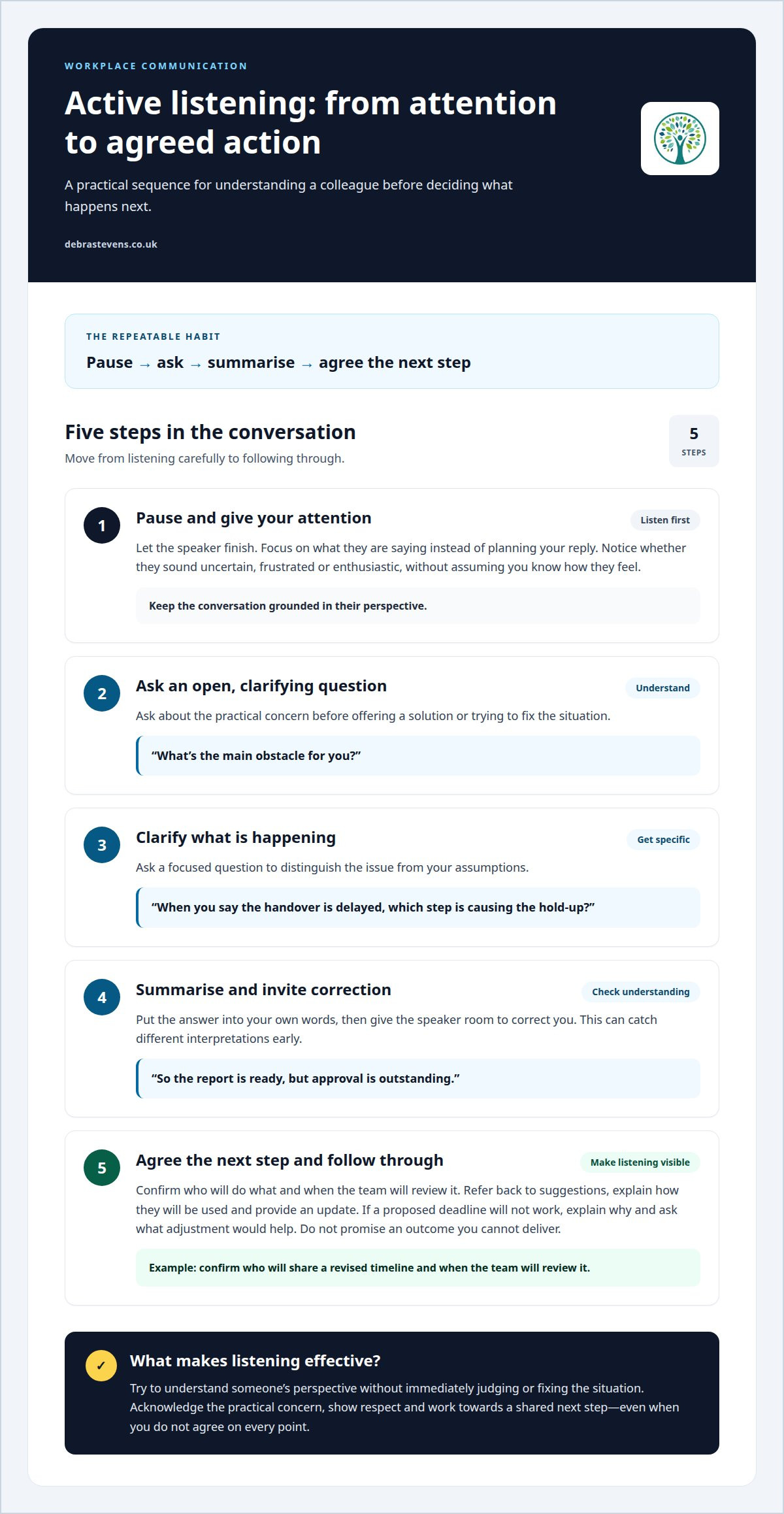
Active listening starts before anyone offers a solution. In a meeting, let the speaker finish and give them your attention instead of planning your reply. Notice whether they sound uncertain, frustrated or enthusiastic, but don’t assume you know how they feel. Ask, “What’s the main obstacle for you?” to keep the conversation grounded in their perspective.
Check your understanding before deciding what happens next. Ask a clarifying question, such as, “When you say the handover is delayed, which step is causing the hold-up?” Then summarise the answer in your own words: “So the report is ready, but approval is outstanding.” Invite the speaker to correct you. This catches different interpretations early and makes communication more effective.
Trust grows when people see that their input shapes the discussion. A manager can demonstrate this by referring to a colleague’s suggestion, explaining how the team will use it and providing an update. If a proposed deadline won’t work, explain why and ask what adjustment would help. Don’t promise an outcome you can’t deliver. Following through on agreed actions encourages people to speak openly in future conversations.
Empathy means trying to understand someone’s perspective without immediately judging or fixing the situation. If a colleague says a new process is difficult, ask which part creates the most friction before suggesting a change. Listen for the practical concern behind their comment, then acknowledge it: “It sounds as though the extra approval is slowing your response to customers.” You don’t have to agree on every point. Showing respect gives both people a clearer starting point for finding a solution.
Make listening a repeatable habit: pause, ask, summarise and agree the next step. In a one-to-one conversation, for example, confirm who will share a revised timeline and when the team will review it. These small actions turn listening into visible behaviour, not just good intentions.
2. What makes communication effective in a business?
Effective workplace communication matches the channel to the message. Use a quick chat for a straightforward update, email when project members need a written record, and a meeting when someone must discuss a complex or sensitive issue. Relying only on messages can create delays and leave questions unresolved. Choosing well supports collaboration, helps leaders make decisions, and keeps teams aligned on priorities.
Prepare for important conversations by identifying the audience, the decision or action needed, and the details people require. Before a project meeting, for example, share its purpose and agenda, then clarify who owns each follow-up and its deadline. If the discussion could be difficult, organise the relevant facts, anticipate questions and focus on the issue, not someone’s character.
In UK workplaces, make communication accessible and handle personal information carefully. Use clear language, provide key details in a format people can understand, and share confidential information only with those who need it. Follow your organisation’s accessibility and confidentiality policies, especially when discussing personal circumstances or performance. This helps everyone participate while keeping sensitive conversations appropriately private.
During disagreements, speak respectfully and describe the specific behaviour or impact at issue. Give the other person space to explain, then agree practical next steps together. Adapt to the individual: someone who prefers time to reflect may respond better to a written summary, while another colleague may value a direct conversation. Ask what format helps them engage instead of assuming one style suits everyone.
Hybrid teams need shared expectations. Record decisions after video meetings, make updates available to colleagues who could not attend, and choose live discussion for issues needing back-and-forth. Set clear norms for which channel carries urgent requests and where project decisions are stored. To build these habits across a team, Communication & Impact Training can help people practise clear, audience-aware communication.
3. How Can Employers Improve Communication Skills Across Their Teams?
Start with the message employees need to act on. Before sending an update, identify its audience, purpose and required response. Put the action and deadline near the top, then remove details that don’t help someone complete the task. For example, replace “Please progress the report” with “Send the revised report to the project lead by Thursday.” A clear request reduces guesswork.
Structure written messages so people can scan them quickly. Use a descriptive subject line, short paragraphs and bullets for related actions. In meeting notes, record decisions, owners and deadlines, then share them with everyone affected. Explain job expectations in plain language too: describe what successful completion looks like, who provides input and where employees can raise questions. This makes responsibilities easier to follow.
Prepare verbal communication just as carefully. In a team briefing, explain why a change is happening before outlining what people need to do. Pause after key points, invite questions and watch for signs of confusion. If someone looks uncertain, ask them to describe the next step in their own words. This checks whether your explanation was clear without putting them on the spot.
Managers foster open, psychologically safe communication by responding constructively when employees raise concerns or admit mistakes. Thank them for speaking up, ask what support would help and follow through on agreed actions. For example, if handovers are unclear, invite employees to share examples and discuss a practical change with the team. Psychological safety in workplace training can help teams practise these behaviours and explore how leaders and processes make speaking up easier.
To improve workplace communication, gather feedback after meetings and look for recurring issues, such as missed handovers or unclear ownership. Compare employees’ feedback with project outcomes, then choose one behaviour to work on. Teams might practise concise updates or clearer requests through coaching, peer feedback and structured workshops. Review the change with employees and adjust it in response to their experience.
4. How can employees improve listening and give constructive feedback at work?
Useful feedback starts with a clear example, not a judgement about someone’s character. Describe the action, explain its effect and agree a practical next step. For instance: “The client update went out after the agreed deadline, so the team couldn’t prepare. Could you flag delays earlier next time?” This keeps the conversation respectful and focused on behaviour the person can change.
Choose a timely moment and suitable setting. Raise a sensitive concern privately rather than in a group meeting or a quick message. Stick to what you observed, avoid guessing someone’s motives and leave room for their perspective. If a handover missed key details, explain what was missing and how that affected the next person’s work.
Listening matters when you give feedback, too. After explaining your concern, pause and invite a response: “How did you see it?” Hear the answer fully, then ask for examples if you need more context. Summarise their point to check your understanding before discussing a practical way forward. This turns feedback into a conversation, not a one-way verdict.
Receiving feedback also takes effort. Resist the urge to defend yourself straight away. Ask what the person noticed and what a stronger approach might look like. If a colleague says your meeting updates are hard to follow, ask which part needs more clarity. Then agree an action, such as sharing the decision and owner in a written recap, and review whether it helps.
Keep feedback specific, respectful and connected to work. Recognise helpful behaviour as well as areas to improve, so colleagues know what to continue. For example, thank someone for raising a risk early, then discuss how to make the next project handover clearer. Practise these conversations through Communication & Impact Training, with realistic opportunities to develop listening and feedback skills.
Debra Stevens Training and Coaching: The Why Factor
Debra Stevens Training and Coaching helps teams strengthen communication and put new skills into practice. When colleagues need to improve listening, give feedback or handle challenging conversations, Communication & Impact Training offers a way to practise more effective approaches.
Conscious Human Skills Workshops use an experiential, drama-based approach, with professional actors bringing realistic role-play scenarios to life. Participants can explore how conversations unfold, try different responses and reflect on their impact in a supportive setting. The Why Factor, Management & Leadership development and Customer Service workshops offer further ways to develop people skills relevant to teams and their work.
Consider practical training when communication challenges keep recurring or a team needs a shared opportunity to practise. Visit debrastevens.co.uk to explore the training and get in touch about your team’s needs.
Make your next conversation count
Choose one moment this week to change how your team works together. Invite a quieter colleague into a discussion, agree a clearer way to share decisions, or make space to practise a challenging conversation. Small experiments give people something specific to reflect on and apply in their everyday work.
A practical next step in building better communication at work is to make development part of the team’s routine. Debra Stevens Training and Coaching offers Conscious Human Skills Workshops and Management & Leadership development, alongside The Why Factor. These programmes help teams develop communication skills through structured learning and practice.
Start with a clear goal: decide what you want colleagues to handle differently, then create opportunities to practise and reflect. Progress begins with an honest conversation and a willingness to try a new approach.
Contact Debra Stevens Training and Coaching to explore a suitable next step for your team.
Frequently Asked Questions
How Can Employers Improve Communication Skills Across Their Teams?
Employers can build communication skills by making development part of everyday work. Identify a recurring challenge, such as unclear cross-team handovers, and give employees a chance to practise a better approach on a live project. Add coaching or peer reflection so people can discuss what worked. Making learning relevant to real team situations is a practical way to improve workplace communication.
What makes communication effective in a business?
Business communication works when people understand what a message means for their work. For example, a product team explaining a change to customer service colleagues should clarify what has changed, which customers are affected and what response is expected. Shared understanding helps teams coordinate decisions and avoid acting on different assumptions. The right level of detail depends on what recipients need to do next.
Why are communication skills important in the workplace?
Communication skills help people coordinate work, resolve uncertainty and raise problems before they grow. Imagine someone on a project spotting a dependency that could delay delivery. Explaining the issue clearly gives colleagues time to adjust plans instead of discovering the problem at handover. Strong communication also helps people share knowledge across roles, so important context doesn’t stay with one person.
Can communication skills help with career progression?
Communication skills can support career progression by helping people explain their thinking, contribute to discussions and build working relationships. An employee proposing a process change, for example, can set out the problem, explain their reasoning and respond constructively to questions. That makes their contribution easier to understand. Communication alone doesn’t determine promotion, but it helps colleagues and managers see how someone approaches responsibility and teamwork.
What are the main characteristics of good communicators?
Good communicators are attentive, clear, respectful and responsive. They adapt the level of detail to their audience and make space for different views. In a planning conversation, for instance, they might invite a colleague to explain a concern before offering their own solution. They also take responsibility for making their meaning clear instead of assuming others understood an unclear message.
What are the key principles of effective workplace communication?
Effective workplace communication depends on clarity, respect, relevance and follow-through. Share information with the people who need it, explain its purpose and make responsibilities easy to understand. After agreeing a change to a shared process, for example, record where the current instructions are kept and who will update them. These principles help teams keep information useful and consistent, particularly when colleagues work in different roles or locations.
One Comment