
Bespoke corporate training should be built around your organisation’s goals, culture and learners, not simply adapted from a standard course. Its scenarios and activities need to reflect the challenges people face at work, so they can practise skills they can use in real situations. That relevance helps make learning feel designed for your team.
A tailored programme can still miss the mark if it doesn’t engage people or connect learning to day-to-day behaviour. You’ll see how to shape training around a clear business need, involve learners and create realistic opportunities to practise.
This article explains how to identify the right focus, design and deliver a programme, embed learning at work and assess what changes. You’ll also learn what to consider when choosing an approach that fits your organisation, rather than asking your people to fit a generic course.
Key Takeaways
- Start by identifying the work challenge and the change you want to see, then design, deliver, embed and measure learning around that outcome.
- Shape leadership development around managers’ real responsibilities, so practice connects directly to the conversations and decisions they face.
- Link learning to your organisation’s goals and culture, while adapting the approach to the people who need to use it.
- Use realistic, relevant scenarios to help learners engage, practise new behaviours and carry their learning into the workplace.
Discover-design-deliver-embed-measure methodology
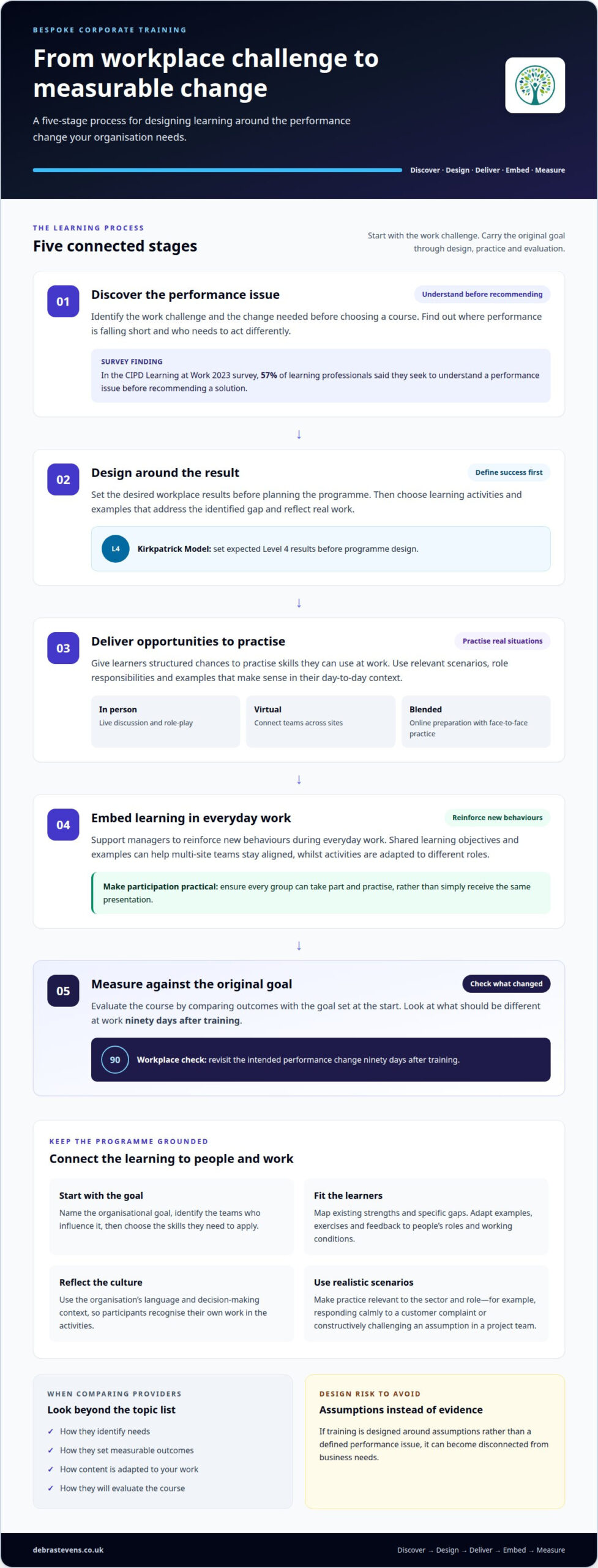
Use five connected steps to turn a workplace challenge into practical learning. For bespoke corporate training, start with the performance change your organisation needs.
Training design and evaluation
Discover: identify the performance issue before choosing a course. In the CIPD Learning at Work 2023 survey, 57% of learning professionals said they seek to understand a performance issue before recommending a solution. Design: define the desired workplace results first; the Kirkpatrick Model recommends setting expected Level 4 results before programme design. Then choose learning activities and examples that address the identified gap. Deliver: give learners structured opportunities to practise. Embed: support managers to reinforce new behaviours during everyday work. Measure: compare outcomes with the original goal, including what should be different at work ninety days after training.
How do you choose a UK provider? Compare how providers identify needs, set measurable outcomes and adapt content to your work. Ask how they will evaluate the course, not just which topics it covers.
What are the benefits and risks? Relevant practice can build skills for real workplace situations. The risk is designing around assumptions instead of a defined performance issue, which can leave the course disconnected from business needs.
Delivery formats and reach
Choose a delivery format that suits the skill being practised and where learners work. In-person sessions support live discussion and role-play; virtual sessions connect teams across sites; blended delivery can combine online preparation with face-to-face practice. For national or multi-site teams, use shared learning objectives and examples, while adapting activities to different roles. Make sure every group can participate and practise, rather than simply receive the same presentation.
What UK laws and regulations apply? Requirements depend on the work, role and risks involved. Include relevant role-specific requirements when identifying needs, then shape instruction and practice around the competence people need for their tasks.
Tailored management and leadership programmes
Leadership development can focus on situations managers handle daily: setting expectations, giving feedback, resolving tension and guiding change. A tailored programme can connect these skills to your organisation’s roles, industry and management priorities, rather than treating leadership as one generic set of behaviours.
UK organisations can tailor programmes around leadership, communication, conflict management, inclusion or management practice. Choose the focus by identifying where managers need to act differently, such as giving clearer feedback or handling challenging conversations with confidence.
Programme costs depend on its scope and requirements. Key considerations include design work, learning objectives, delivery format and level of customisation. A clear brief helps you compare the planned scope with your budget, then prioritise essential practice and follow-up rather than cutting elements at random.
Some bespoke programmes can include accredited pathways aligned with CMI and ILM. ILM Level 3 and Level 5 leadership and management qualifications are options in the UK market. Check how any qualification fits the programme’s objectives, assessment requirements and learners’ development needs before building it into a pathway.
Set the programme length around the skills to develop and the time learners need to practise them. A focused workshop may suit a specific management challenge; broader development can use spaced sessions, workplace tasks and feedback between modules. Blended learning can combine facilitated sessions with online activities, giving managers opportunities to reflect and apply ideas between meetings.
For example, managers could explore feedback in a facilitated session, practise a conversation, then reflect on a real workplace discussion. To explore a relevant option, see leadership and management training that can address practical workplace skills.
Training tailored to organisational goals and culture
Start with the organisational goal, then identify the behaviours that can move it forward. The programme should reflect how people work, communicate and make decisions in your culture.
Alignment with organisational goals
According to the LinkedIn Workplace Learning Report 2024, aligning learning with business goals was the top learning and development focus for the second consecutive year. Turn that priority into a practical brief: name the goal, identify the teams who influence it, then choose the skills they need to apply. For example, a customer experience goal may call for clearer communication and more consistent responses.
Tailoring to organisational needs
Tailoring begins with the people, roles and working conditions involved. Map existing strengths alongside specific gaps, then adapt examples, exercises and feedback to those needs. A new manager may need to practise setting expectations, while an experienced team may need support navigating change. Align the learning with the organisation’s language and decision-making, so participants recognise their own work in the activities.
Sector context matters because the same skill appears differently across workplaces. In a customer-facing team, communication may mean responding calmly to a complaint; in a project team, it may mean challenging an assumption constructively. Leadership development should reflect these real demands. Use sector-specific scenarios, role responsibilities and workplace terminology, rather than generic examples that leave learners guessing how to apply the lesson.
Culture also shapes whether new behaviours take hold. Identify the habits that support your goals and those that may get in the way, such as avoiding difficult conversations or relying on informal decisions. Then build practice around the behaviour you want to encourage. If an organisation is changing how teams collaborate, exercises can help people rehearse sharing concerns, clarifying responsibilities and responding openly to feedback.
Finally, connect learning to change beyond the session. Ask managers to reinforce agreed behaviours in team discussions and everyday decisions. Review whether those actions are becoming visible at work, then adapt future learning to address any remaining gaps.
Learner engagement and relevant scenarios
Engagement depends on whether learners recognise their work in the course. Learners may quickly spot whether training was written for them. Use that response to test relevance: do the examples reflect their roles, pressures and decisions, or could they belong to any workplace? Custom scenarios make practice specific, not merely familiar.
Build each scenario from a real task. Identify the people involved, the challenge and the behaviour learners need to practise. For example, a team handover exercise could ask participants to clarify ownership, share a concern and agree the next action. Keep the situation recognisable, then vary the responses so learners can explore different ways forward.
Actor-supported role-play can bring a difficult conversation to life without relying on slides alone. A facilitator can pause the scene, invite learners to try a response, then replay the moment with a different approach. This gives participants room to experiment, observe consequences and discuss what worked. Keep the practice connected to the specific skill, such as listening before responding.
Psychological safety matters during practice. Set clear ground rules before a scenario begins: respect confidentiality, focus feedback on behaviour and let participants learn without ridicule. After a role-play, ask what the person intended, how their words may have landed and what they could try next. This creates useful reflection rather than a vague judgement about performance.
Keep engagement active throughout the session. Alternate short explanations with paired practice, group reflection and individual planning. For a virtual course, use breakout discussions and realistic prompts; in person, use small-group rehearsal. End with a specific workplace action, such as applying a new questioning technique in an upcoming team conversation, then reflect on what happened.
Ready to build more relevant, engaging learning? Explore tailored training options for your organisation.
Debra Stevens Training and Coaching: The Why Factor
Debra Stevens Training and Coaching helps organisations develop practical people skills through experiential workshops and coaching. Turn to The Why Factor when you want learning connected to workplace behaviour, communication and organisational goals. Its drama-based approach uses professional actors in realistic role-play scenarios, giving participants space to practise responses and reflect on their impact.
For managers, Leadership & Management Training can focus on the everyday challenges of leading people. Customer Service Excellence supports teams aiming to strengthen customer interactions, while Conscious Human Skills Workshops focus on interpersonal skills. The right starting point depends on the capabilities your people need to build and the situations they need to handle.
To discuss training for your organisation, contact Debra Stevens Training and Coaching or visit debrastevens.co.uk.
Turn your development priorities into action
Choose one workplace behaviour your organisation wants to strengthen, then use it to shape your next development conversation. A focused starting point helps you decide who needs to take part, which situations they need to practise and how managers can support change afterwards. Keep the intended shift visible as priorities evolve, so learning stays connected to the work people do.
Debra Stevens Training and Coaching can help organisations explore that next step through The Why Factor, Conscious Human Skills Workshops and Leadership & Management Training. Consider how bespoke corporate training could support the people and behaviours central to your goals, rather than treating development as a one-off event.
Bring your priorities and questions to a conversation with Debra Stevens Training and Coaching. A clear starting point can open the door to meaningful progress.
Frequently Asked Questions
What Exactly Defines Bespoke Corporate Training?
Bespoke corporate training is designed for an organisation’s particular needs, learners and working context. The difference should show in the learning itself, not just the branding. For example, a practice exercise might reflect how a team handles a handover, helping participants rehearse an interaction they recognise and can apply in their roles.
How do you measure return on investment?
Compare programme costs with relevant, evidenced benefits. First, agree what improvement matters and how you’ll recognise it. A sales team might track an agreed business indicator alongside observations of how staff handle customer conversations. Consider non-financial outcomes too, such as whether people apply a skill more consistently. Avoid attributing every workplace change to training alone.
What is training tailored to an organisation?
It is learning shaped around a specific organisation’s context, people and objectives. For instance, a team that regularly negotiates project deadlines could practise setting boundaries and reaching workable agreements. This differs from simply adding an organisation’s logo to existing slides. The examples, activities and language should help participants connect the learning with their actual responsibilities.
How much does tailored corporate training cost in the UK?
The price depends on the requirements and is given after a quote request. Scope, programme design, delivery format and the degree of tailoring shape the cost. Debra Stevens Training and Coaching can work to your budget, allowing the programme’s content and format to be considered against your priorities. Share the intended outcomes and audience when discussing a potential programme.
How is bespoke corporate training designed and delivered?
Start by agreeing the workplace need, intended learners and practical outcomes. Then shape the content, activities and examples around those details. Delivery may be in person, virtual or blended, depending on the learning activities and how participants work. For instance, presentation practice could include preparation, a role-relevant presentation and structured feedback.
Tailored vs off-the-shelf training: what are the differences?
Tailored training is created for an organisation’s specific context; off-the-shelf training follows an existing course structure. A standard course may suit a shared foundation, such as introducing a common concept. Bespoke corporate training is useful when learners need to practise situations unique to their roles or workplace. Compare the fit, content and activities with the capability you need to develop.



One Comment