

What if the best people to train aren’t only those who handle complaints? Customer service excellence training benefits everyone who speaks with customers, from frontline teams to managers shaping service standards. It helps staff communicate clearly, respond constructively when things go wrong and keep customer needs at the centre of their decisions.
Good service takes more than a friendly greeting. Teams need shared skills and confidence to listen, explain options and handle challenging conversations without losing sight of the person behind the issue.
This guide explains who can benefit, what effective training covers and how practical learning can strengthen communication and complaint-handling skills. It also explores how training can support a more consistent, customer-focused culture across your organisation.
Key Takeaways
- Identify which customer-facing roles can benefit, including the people who shape service standards behind the scenes.
- Adapt your communication to each channel, using clear, persuasive language that helps customers understand their options.
- Build a practical approach to complaints and challenging interactions that keeps conversations constructive.
- Connect customer expectations with everyday team behaviours to strengthen a consistent, customer-focused culture.
Customer communication channels and persuasive language
Customers move between phone, email, live chat and face-to-face conversations, and each channel affects how a message lands. Customer service excellence training helps teams adapt their language and listening while keeping responses focused on customer expectations.
Active listening and communication styles
Active listening means giving customers space to explain, then checking your understanding before responding. On a phone call, a team member might summarise: “The delivery arrived, but the item was missing.” In live chat, the same skill could mean acknowledging the issue and asking a relevant follow-up question.
Customers differ in how much detail they want. Someone seeking a quick answer may value a direct response, while another may need each step explained. Notice their cues, adjust your pace and check what they need. A customer service excellence training course can use paired role-play to help team members practise this flexible approach.
Clear communication and empathy
Clear language makes the next step easier to understand. Replace internal terms with a plain explanation: instead of “the request is being escalated”, say, “I’m passing this to the team that can help, and I’ll explain what happens next.” This gives the customer a clear action without promising an outcome the team cannot control.
Empathy means recognising the customer’s experience, not relying on a scripted apology. In an actor-supported scenario, a team member might say, “I can see this has disrupted your plans,” then ask what matters most. Well-designed customer service excellence training lets staff practise tone, timing and wording, then reflect on how these choices shape the conversation.
Persuasive language should guide, not pressure. If a customer needs written confirmation, connect your response to that request: “I’ll send the details by email.” Reviewing sample exchanges can also reveal jargon, unanswered questions and unclear commitments. Ask whether each reply identifies the issue, acknowledges the concern and explains the next step. This helps teams build consistent, attentive communication across channels.
Complaints handling and challenging interactions
A complaint can test a customer relationship and expose gaps in a service process. A clear response helps staff understand the issue, address its impact and agree a practical next step.
Handling customer complaints
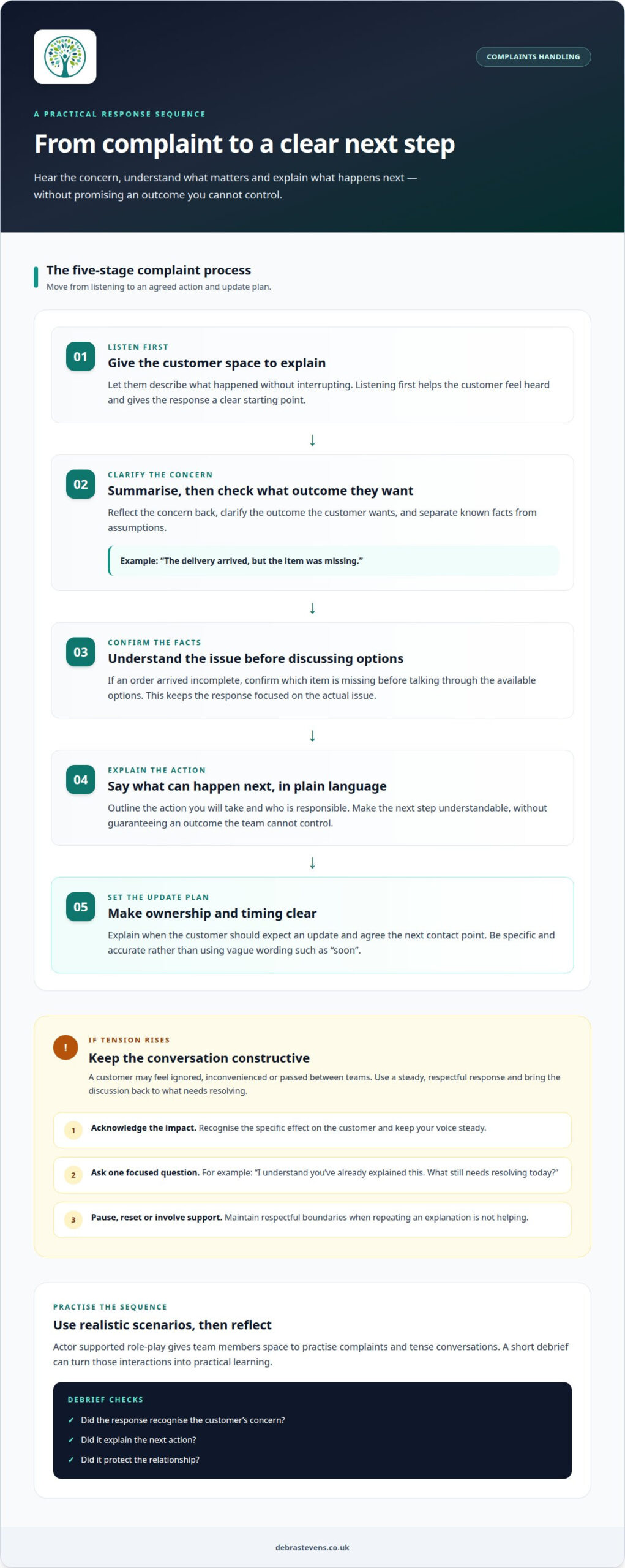
Start by letting the customer explain what happened without interrupting. Then summarise the concern, clarify the outcome they want and separate facts from assumptions. For example, if an order arrived incomplete, confirm which item is missing before discussing available options. This shows the customer they have been heard and gives the response a clear focus.
Good complaint handling also means explaining what can happen next in plain language. Staff can outline the action they’ll take, who is responsible and when the customer should expect an update, without promising an outcome they can’t control. Choose learning that lets team members practise this sequence with realistic examples, rather than memorising a script.
Managing challenging interactions
Some interactions become difficult when a customer feels ignored, inconvenienced or passed between teams. Staff can lower tension by keeping their voice steady, acknowledging the specific impact and asking one focused question. For example: “I understand you’ve already explained this. What still needs resolving today?” This redirects the conversation towards a useful next step.
When a conversation becomes challenging, staff should know how to maintain respectful boundaries and involve appropriate support. Practice scenarios can help them recognise when repeating an explanation isn’t helping, pause and reset the discussion. Focus on how word choice and tone affect the interaction, rather than labelling someone a “difficult customer”.
Actor-supported role-play gives team members space to practise complaints and tense conversations, then reflect on what changed the exchange. A short debrief can ask: did the response recognise the customer’s concern, explain the next action and protect the relationship? These observations turn individual interactions into practical learning that can strengthen a consistent service culture.
For teams ready to practise these skills, customer service excellence learning can bring realistic complaint scenarios into development sessions.
Customer expectations and satisfaction
Customers judge service against what they need, what they expect and what actually happens. Teams can use practical techniques to understand those differences and respond in ways that build rapport.
Understanding customer needs and wants
A need is the outcome a customer must achieve; a want is how they’d prefer to achieve it. For example, someone replacing a faulty kettle needs a working appliance but may want a replacement delivered rather than a refund. Asking what matters most helps staff distinguish the essential outcome from the preferred option.
During a training course, participants can practise asking open questions and checking their understanding. “Is getting a replacement the priority, or would another solution work?” gives the customer room to explain. Look for exercises that help staff respond to the answer, rather than follow a fixed script.
Managing customer expectations
Expectations become harder to manage when a customer assumes an action is immediate but the process takes longer. Staff should explain the next step, what it involves and when they’ll provide an update. For example, if a service request needs investigation, describe that process before the customer has to chase for progress.
Clear explanations also distinguish what’s known from what still needs resolving. Participants can practise replacing vague wording such as “soon” with a specific, accurate update plan. Agree the next contact point, make ownership clear and apply that approach consistently across the team.
Customer satisfaction and loyalty
Satisfaction depends on whether the experience meets the customer’s stated needs and expectations, not simply on a friendly interaction. If a customer asks for an accessible appointment time, offering a suitable option shows the team has acted on what they said. Repeated experiences of being understood can help build loyalty and lasting rapport.
Use customer feedback and recurring service issues to identify where expectations and delivery diverge. A team might find that customers understand a product but need clearer delivery updates. Practise the revised explanation, then observe whether staff use it consistently. This connects learning to everyday behaviour without assuming every customer has the same priorities.
Customer service culture and customer satisfaction
A customer-focused culture takes shape through everyday decisions, not slogans. Each team member needs to understand how their choices affect the customer experience.
Building a customer-focused culture
For an organisation to put customers first, service principles must guide teams beyond the contact centre. For example, if customers regularly struggle to understand delivery updates, operations and customer-facing staff can discuss where the process breaks down. Shared knowledge helps teams address the cause instead of repeatedly treating the same symptom.
Look for learning that connects service behaviours with real workplace situations. A team could practise explaining a process clearly, then discuss how managers can support that behaviour. This makes customer focus part of decisions across roles, rather than leaving it solely to frontline staff.
Choose training that reflects your organisation’s customers, service challenges and desired learning outcomes. Consider how realistic situations can build usable skills, rather than relying only on general advice.
UK training options include customer communication, complaint handling and service culture workshops. They may be tailored for customer-facing teams or managers shaping service standards.
Training can take the form of a focused workshop or a broader programme, depending on the skills and situations covered. Delivery may be online or in person, depending on the course design.
Customer service learning can be non-accredited or form part of a qualification with assessment. Match the learning outcomes and any accreditation to the role and development goal.
Training mistakes and risks
A common mistake is teaching polished phrases without practising the judgement behind them. In a role-play about a delayed order, a fixed script may sound unnatural when the customer raises a different concern. Practice should let staff adapt their response while staying clear, respectful and within the organisation’s processes.
Another risk is treating training as a standalone event. If managers don’t discuss the skills afterwards or reinforce them in team routines, new approaches can fade. Build in follow-up discussions using real service situations, and identify where policies or knowledge need to support the behaviours being practised.
Develop a more customer-focused service culture by turning everyday situations into practical team learning.
Debra Stevens Training and Coaching: Customer Service Excellence
Debra Stevens Training and Coaching delivers Customer Service Excellence training to help customer-facing teams practise the skills that shape better service. Experiential workshops use actor-supported role-play to bring realistic customer situations into the learning, giving participants space to try different responses and reflect on their impact.
Turn to this training when your team needs to strengthen communication, handle complaints with greater confidence or build a more consistent customer-focused approach. Programmes are tailored to organisational needs, so practice can reflect the situations your people encounter at work. The Why Factor and Conscious Human Skills Workshops can also support wider development in understanding people and working effectively together.
Book a call with Debra Stevens Training and Coaching to discuss your team’s customer service development needs.
Turn service intentions into everyday practice
Start by choosing one customer interaction your team wants to handle with greater confidence, then make it a focus for development. Customer service excellence training can turn that priority into practical learning shaped around the situations your people face.
Debra Stevens Training and Coaching also offers The Why Factor, Conscious Human Skills Workshops and Leadership & Management Training. These can support wider development in how teams understand people, work together and reinforce customer-focused behaviours.
Start a conversation about the service challenges your team wants to work on and the skills you want to strengthen. Contact Debra Stevens Training and Coaching to explore a suitable next step for your organisation.
Stronger customer experiences begin with a deliberate choice to practise. Take that step and help your team put thoughtful service into action.
Frequently Asked Questions
Who should attend?
Customer-facing team members are the core audience, including staff who support customers by phone, email, chat or in person. Team leaders can also attend to explore how their guidance shapes service delivery. For example, a team handling product enquiries and a manager reviewing customer feedback may both benefit while practising different responsibilities within the same service experience.
How much is it?
The cost depends on the programme, and you can request a quote. Factors include the training design, delivery format and whether professional actors are included. Because programmes are tailored to organisational needs, the scope reflects your team’s development priorities and the situations they need to practise. Book a call with Debra Stevens Training and Coaching to discuss your requirements.
How will I benefit?
You can build practical confidence in customer-facing situations and develop a more considered approach to service. For instance, a team member who finds it difficult to explain a service limitation can practise clear, respectful wording in a realistic scenario. Sessions also give teams shared experiences to discuss, helping colleagues recognise how individual actions contribute to the customer’s overall impression.
What will you learn?
You’ll develop skills relevant to the customer situations your organisation wants to address. These may include adapting your approach, responding constructively when a conversation becomes tense and understanding how your behaviour affects others. Interactive role-play lets participants try different responses and reflect on them. The learning can then be connected to how your team works day to day.
Who is it for?
It’s suitable for organisations that want to develop customer service capability across a team, rather than focus only on individual performance. Retail, hospitality, transport, finance, healthcare and education teams may face different service situations, so tailored programmes can reflect their working context. It can also suit managers who want to reinforce customer-centred behaviours through everyday decisions and team discussions.
Why should you go?
Choose practical learning if you want to explore how service skills work in real interactions, not just discuss them in theory. Actor-supported scenarios create space to test responses and consider their effects before applying new approaches at work. This is useful when a team wants to build confidence together or address recurring challenges through shared practice and reflection.