

A customer explains the same problem twice. You’re already thinking of a solution, but they still don’t feel heard. If you’re asking how to improve customer service skills, start by pausing long enough to understand what matters to the person in front of you.
Customer service is more than answering a question or fixing a problem. It’s how you listen, communicate and work with someone so they feel understood and know what happens next. In my 26 years in training, I’ve seen how a small shift in a conversation can change its direction.
You’ll learn how active listening and empathy support thoughtful responses, how personalisation makes an interaction feel relevant, and how practising realistic scenarios builds confidence. Try one small change: before offering a solution, ask, “What’s the most important thing for you right now?” Then notice how the question lands. Stronger service skills begin with that kind of attention.
Key Takeaways
- Pause before you respond, and use a clarifying question to understand what the customer needs.
- Build confidence with the product knowledge and clear explanations that help customers decide what to do next.
- Adapt your response to the person’s situation, rather than relying on a one-size-fits-all script.
- Practise realistic customer conversations, reflect on how your response lands, then try again.
1. Active listening and empathy
Active listening, empathy, clear communication, patience and problem-solving are central customer service skills. Teamwork matters too: a colleague may know how to resolve an issue you can’t handle alone. To improve customer service skills, practise identifying what the customer needs before deciding what to say.
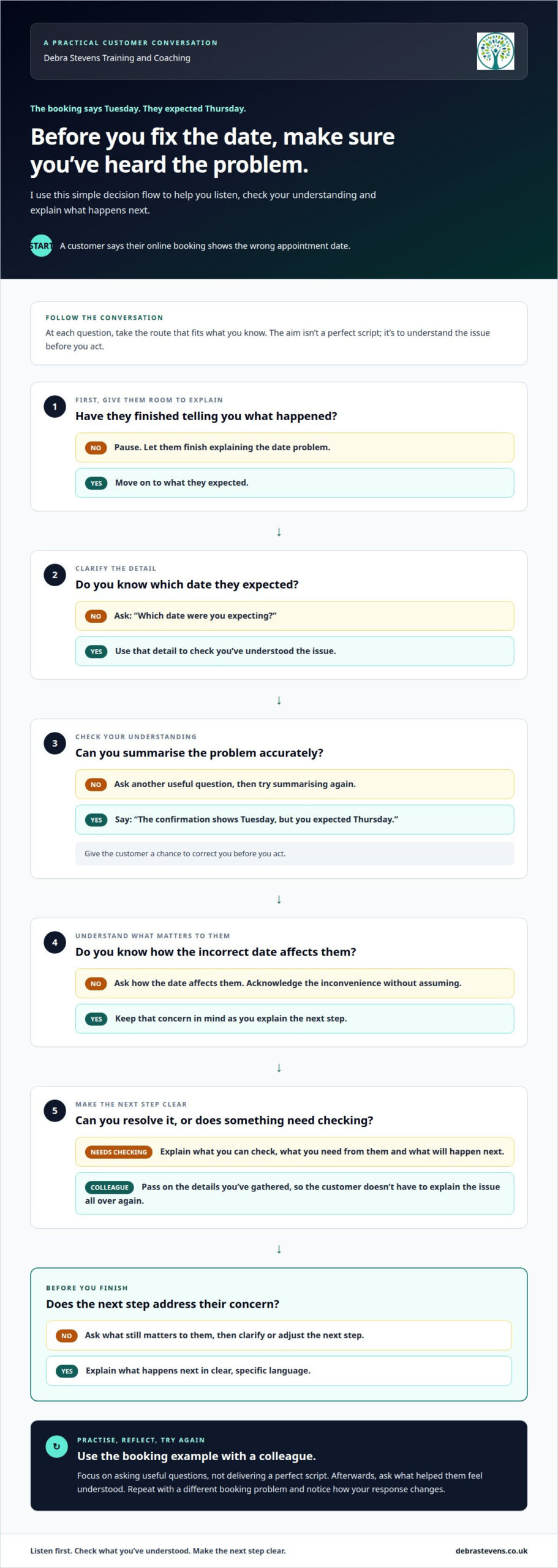
Imagine someone calls because an online booking shows the wrong appointment date. Rather than blame the system or rush to change it, let them explain what they expected. Acknowledge the inconvenience and ask how the incorrect date affects them. This shows empathy without assuming you already understand the whole story.
Use a clarifying question to fill any gaps. “Which date were you expecting?” gives you something specific to check. Then summarise: “So the confirmation shows Tuesday, but you expected Thursday.” The customer can correct you before you act. This is a practical way to strengthen listening and avoid solving the wrong problem.
Clear communication makes the next step easier to follow. Explain what you can check, what you need from the customer and what will happen next. If a colleague needs to take over, pass on the details you’ve gathered. The customer shouldn’t have to explain the appointment issue all over again.
Practise the booking example with a colleague. Focus on asking useful questions, not delivering a perfect script.
- Let the customer finish explaining the date problem.
- Acknowledge the disruption without becoming defensive.
- Ask one question, then summarise the issue in your own words.
- Describe a clear next step and check that it addresses their concern.
Afterwards, ask your colleague what helped them feel understood. Repeat the exercise with a different booking problem and notice how your response changes.
2. What is customer service?
Customer service is how you help people before, during and after they use a product or service. It includes practical actions, such as answering a question, explaining an option or resolving a problem. Salesforce found that 80% of customers believe the overall experience matters as much as the product or service itself.
Good intentions need sound knowledge behind them. If someone asks whether a coat is machine washable, an accurate answer depends on knowing its care instructions. Product knowledge also means understanding common limitations, relevant industry terms and when a question needs specialist support. Reliability comes from giving an answer based on facts, not guesswork.
A shared knowledge base can help staff find consistent answers about product features, processes and common issues. Keep it useful by reviewing entries when a policy or product changes. Customer feedback is another practical source of learning: if several people find the returns instructions confusing, review the wording and steps they must follow. Then share the update with the team.
Measure performance by looking for patterns in customer feedback and operational figures, such as orders and complaints. Track recurring issues, identify whether they relate to staff knowledge, processes or policies, then choose an action and review whether the problem continues.
Common mistakes include guessing, using jargon, rushing to an answer and making promises you can’t keep. For example, explain what you know about a delayed order, distinguish it from what you still need to find out, and give a clear next step. That’s more positive and trustworthy than false certainty, and can support customer loyalty.
To develop this knowledge, take one recent customer question and find the approved answer in your team’s resources. Notice where the explanation feels unclear, then practise saying it simply. If your team wants to build confidence through practice, explore customer service skills practice.
3. Personalisation and proactive service
A customer wants to feel recognised, not processed. McKinsey says 71% of consumers expect personalised interactions, and 76% get frustrated when companies don’t provide them. Personalisation doesn’t mean guessing what someone wants. It means using what they tell you to shape a relevant response.
Start with the situation in front of you. If someone contacts you about a delayed order, explain the information that applies to their order and what happens next. If they’ve already described the issue, don’t make them repeat it. A small detail, such as using their preferred name or remembering a stated preference, can make the interaction feel more considered.
Proactive service means identifying a useful next step before the customer has to ask. For example, if a customer reports a missing part, explain how the issue will be handled and what information you need. Keep them informed if the next step changes. Avoid promising a result or timeline unless you can deliver it.
Try this simple sequence during your next interaction:
- Use the customer’s stated need to tailor your response.
- Explain the next action in plain, specific language.
- Check whether that action addresses their situation.
Personal presentation contributes to the customer experience too. In a face-to-face conversation, a tidy appearance and correctly worn uniform, where required, help create a professional impression. Online or by phone, your greeting, written tone and attention to detail make that impression instead. Adapt to the channel while keeping your communication clear and respectful.
You can develop these behaviours through training and practice. Try the same scenario with different customer needs: one person wants a quick answer, while another needs the options explained. Notice how changing your language or next step affects the interaction. Personalised service isn’t an extra flourish; it means solving the actual problem in a way that suits the customer.
4. Role-playing customer service scenarios
A customer says their complaint has been ignored, and your first response comes out defensively. That can happen in practice, where you can pause, notice the impact and try again before a real customer is waiting.
Role-play turns familiar situations into opportunities to rehearse specific actions. One person plays a customer whose faulty item is needed for an event; another responds as the employee. Give the customer clear expectations and a realistic concern. The aim isn’t a perfect performance. It’s to practise a response that helps them feel valued and moves towards a useful next step.
To handle a difficult customer professionally, stay calm, acknowledge the complaint and ask what outcome they need. Explain what you can do, take responsibility for the next action, and involve a manager if the situation feels out of control.
For a useful practice round, play the conversation once without stopping. Then reflect together: did the employee interrupt, make assumptions or promise something beyond their control? Choose one moment to change, then replay the scene. The second attempt lets you test whether a different phrase or calmer pace changes the conversation.
Professional business actors can make scenarios feel closer to real interactions. Their role isn’t entertainment. They respond to what the employee actually says, helping them notice whether their words meet the customer’s expectations. Observation and immediate feedback create a cycle: try, reflect, adjust, then try again.
Success isn’t about memorising a script. A customer may raise the same issue with a different emotion or reject the first solution. Practise adapting while staying clear, respectful and focused on what can happen next. Ask an observer: “At what point did the customer seem heard, or not?”
If your team needs space to practise before it counts, discuss customer service training shaped around realistic conversations.
Debra Stevens Training and Coaching: Customer Service Excellence
Debra Stevens Training and Coaching’s Customer Service Excellence training helps you turn listening, empathy and clear communication into practical skills. If your team understands the principles but struggles with difficult conversations in the moment, realistic practice can help bridge the gap.
Our training uses realistic workplace scenarios, professional business actors, observation and immediate feedback. You can try a conversation, notice how your words land, then have another go. The actor is part of the feedback process, helping you explore how a customer might respond. Training is tailored to your organisation, so practice can reflect the situations your people face.
To explore customer service training for your team, book a call with Debra Stevens Training and Coaching to discuss your needs.
Make practice part of the next conversation
Change doesn’t need to begin with a grand plan. Choose one conversation your team finds difficult, then make space to practise, reflect and try again. That turns “we should handle this better” into something you can work on together.
If you’re considering how to improve customer service skills across your team, start by asking what would make the biggest difference to the people you serve. I’d be curious to hear which conversations feel hardest, and where a chance to practise might help.
You don’t need every answer before beginning. A clear conversation about the situations your team faces can help identify where practice would be useful. Contact Debra Stevens Training and Coaching to discuss your training brief and what your team needs.
Pick one conversation. Practise it with curiosity. Then notice what changes in your next attempt.
Frequently Asked Questions
What is customer service?
Customer service is the help and information a business gives people as they consider, use or need support with a product or service. It can happen in a shop, by phone, through email or online chat. For example, helping someone choose the right size before purchase is customer service, as is explaining how to use an item afterwards.
How can you improve communication and active listening skills for customer service?
Practise listening for both the facts and the customer’s main concern. If someone says, “I can’t access my account before a meeting,” their immediate need may be timely access, not a general explanation of password settings. Ask a focused follow-up, then summarise what you understand. Use short, plain sentences and give the customer room to correct you.
What steps should you follow to resolve customer problems effectively?
First, establish what happened and what the customer needs now. Next, check relevant records or guidance before choosing an action. Explain the option clearly, including any next step the customer must take. If you can’t resolve the issue yourself, pass it to the appropriate colleague with the key details. Close by confirming what you’ve agreed, rather than assuming the problem is solved.
How can you improve empathy and emotional intelligence in customer service?
Notice your own reaction when a conversation becomes tense. A customer’s sharp tone may prompt you to speak faster or defend a decision. Pause, breathe and choose a calm response instead. Then consider the situation from their perspective. A phrase such as “I can see why that’s upsetting” acknowledges emotion without claiming to know exactly how they feel.
How can you practise customer service skills through role-play or training?
Choose a realistic situation, such as a customer disputing a charge, and practise responding with a colleague. After the first attempt, ask what sounded clear and where the conversation became stuck. Change one thing, then try the scenario again. Structured training can add observation and feedback, helping you test different responses before using them in a live customer interaction.
How do customer service skills differ between phone, email, chat and face-to-face support?
The aim stays the same, but each channel calls for different cues. On the phone, your pace and tone carry meaning; in email, organise the answer so the action is easy to find. Chat benefits from concise messages and clear turn-taking. Face-to-face, show attention through your posture and expression, while avoiding assumptions based on appearance.






One Comment