

A successful leadership workshop isn’t the same as lasting change. Measuring the impact of leadership training means looking beyond participant reactions to whether leaders use new skills at work and whether those changes support team and organisational goals. Start with a clear baseline, then compare it with evidence gathered after the programme.
It makes sense to want a clear sign that time and effort are translating into better leadership. Satisfaction scores and confidence can tell you something about the learning experience, but they don’t show on their own whether day-to-day behaviour has shifted. This guide explains practical ways to track a leader’s progress, including 360-degree feedback, follow-up conversations and relevant business measures. It also explores when changes may become visible, how to distinguish early learning from sustained behaviour change, and why results need to be interpreted alongside other influences. Use these ideas to build a balanced picture of effectiveness, identify what helps leaders apply their learning, and decide where further support can strengthen progress.
Key Takeaways
- Use the Kirkpatrick levels to distinguish positive reactions from learning, changed workplace behaviour and wider results.
- Use 360-degree feedback to understand how a leader’s behaviour is experienced by people around them, not just by the leader.
- Set a baseline and choose a small number of relevant measures so progress is easier to track over time.
- Connect leadership development to organisational priorities, while interpreting business changes alongside other factors that may influence them.
How long does it take to see results from leadership development?
Use Kirkpatrick’s four levels to assess reactions, learning, workplace behaviour and organisational results. Early feedback can guide programme improvements, while later measures show whether skills are being applied and supporting outcomes.
Kirkpatrick’s four evaluation levels
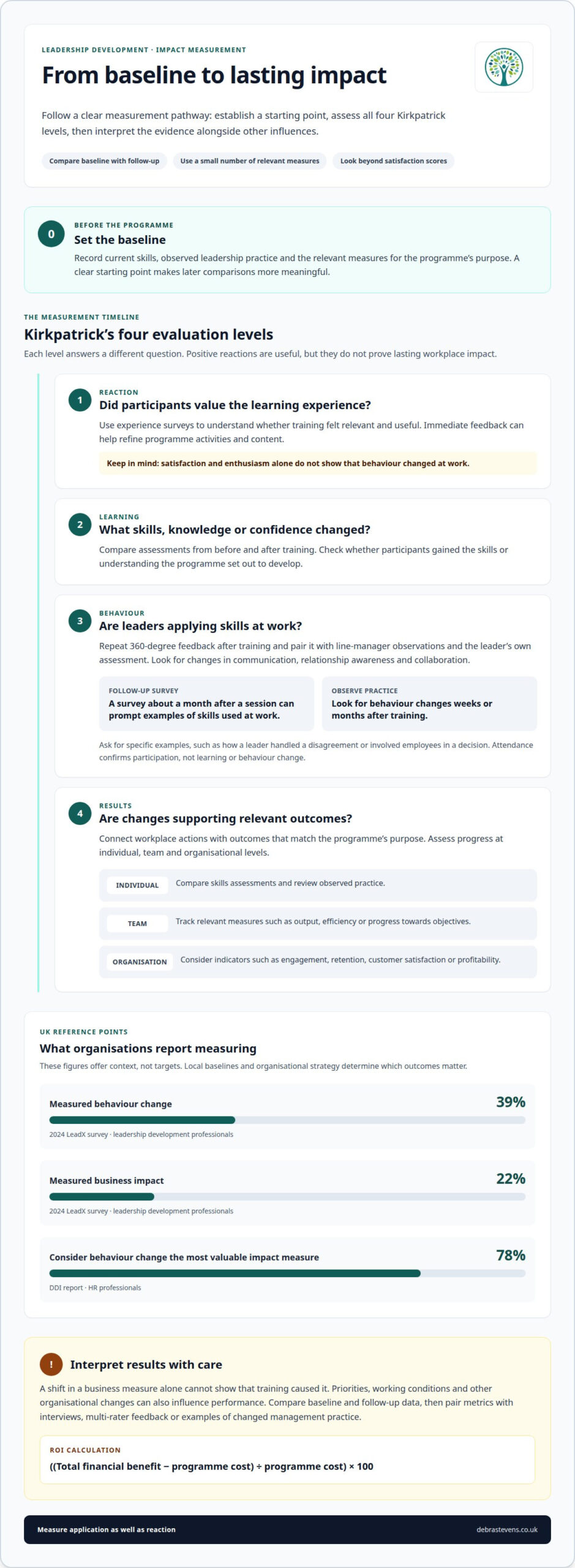
Kirkpatrick’s model evaluates training through Reaction, Learning, Behaviour and Results. Each level answers a different question, from whether participants valued the session to whether workplace performance changed. Compare baseline and follow-up evidence rather than treating positive reactions as proof of lasting impact. Immediate feedback can help refine activities; later observations show whether employees use new skills at work.
Behaviour change and business impact
Behaviour change means applying learned skills at work; business impact means connecting those actions with outcomes such as productivity or team performance. Observe leadership practice weeks or months after training, then compare relevant measures with the starting point. The 2024 LeadX survey found 39% of leadership development professionals measured behaviour change, while 22% measured business impact.
In the UK, training costs depend on the case and are provided after a quote request; scope, format and participant numbers shape the price. Calculate ROI by subtracting programme cost from total financial benefit, dividing by cost, then multiplying by 100. Treat the result carefully: other organisational changes can also affect performance.
Measuring outcomes across organisational levels
Assess progress at individual, team and organisational levels to connect personal development with wider priorities. For an individual, compare skills assessments before and after training, then review observed practice. At team level, track relevant measures such as output, efficiency or progress towards objectives. At organisational level, consider indicators such as employee engagement, retention, customer satisfaction or profitability.
Choose measures that match the programme’s purpose. If the goal is better decision-making, for example, look for evidence of changed decisions in practice alongside relevant team outcomes. A baseline makes later comparisons more meaningful, but a shift in a business metric alone cannot show that training caused it.
Challenges and UK evidence
Leadership influences people, team dynamics and culture, so isolating the contribution of training is difficult. Engagement, retention and performance can change for other reasons, including shifting priorities or working conditions. Compare baseline and follow-up data, and pair metrics with interviews or examples of changed management practice to understand the factors behind the results.
For UK teams, published reference points include the 2024 LeadX survey: 39% measured behaviour change and 22% business impact. DDI reports that 78% of HR professionals consider behaviour change the most valuable impact measure. Treat these figures as context, not a target; local baselines and organisational strategy determine which outcomes matter.
360-Degree feedback
360-degree feedback adds perspectives from people who work with a leader. Combine it with follow-up surveys and reflective feedback to see whether behaviour changes beyond the training session.
Multi-rater and 360-degree feedback
360-degree feedback gathers views of a leader’s performance from people above, alongside and under them. Repeating the assessment after training helps reveal whether others notice changes in communication, relationship awareness or collaboration. Pair these ratings with line-manager observations and the leader’s own assessment. Differences between perspectives can highlight strengths or behaviours needing further practice, rather than reducing progress to one score.
Interviews and reflective feedback
Interviews, focus groups and reflective accounts provide qualitative evidence of how leadership skills appear at work. Ask participants and colleagues for specific examples, such as how a leader handled a disagreement or involved employees in a decision. These details can reveal barriers, enabling conditions and context behind survey results. Reflection also helps leaders connect feedback with actions they can practise and review.
Surveys and participant satisfaction
Experience surveys show whether participants found training relevant and useful; follow-up surveys explore whether they retained and applied what they learned. A survey about a month after a session can prompt examples of skills used at work. These tools answer different questions: immediate feedback can improve programme content, while later responses indicate application. Track employee engagement alongside leadership feedback when it directly relates to the development goal.
Limits of attendance and self-reports
Attendance records confirm participation, not learning or behaviour change. Satisfaction scores show how participants experienced a session, but enthusiasm alone does not demonstrate workplace impact. Self-reports may also miss gaps between a leader’s intentions and colleagues’ experiences. Compare them with multi-rater feedback, interviews or observed examples. A leader may report delegating more, for instance, while team members can describe whether responsibilities actually shifted.
How to measure a leader’s progress?
Choose a small number of meaningful measures and combine assessment data with evidence from everyday work. Follow progress over time to see whether learning transfers into practice and supports a healthier organisational climate.
Assessment data and learner trends
Assessment data can compare a leader’s skills, confidence or knowledge at different programme checkpoints. Start with existing performance information, then add focused surveys or self-reflections if they reveal a useful trend. Track a few relevant measures rather than every available metric. For example, compare a decision-making assessment with later project feedback. Blanchard’s framework spans six evaluation levels, from participant reactions to organisational climate and bottom-line impact.
Review patterns across participants as well as individual scores. If several leaders report greater confidence but show little change in their work, the programme may need more opportunities to apply learning in practice.
Applying learning in the workplace
Workplace application means a leader uses new skills during real tasks and conversations. Set a follow-up point weeks or months after training, then gather observations from line managers, colleagues or team members. An action plan can identify a behaviour to practise, such as inviting quieter employees into a meeting. Coaching, mentoring and peer learning groups can help participants reflect on and sustain that practice.
Track activity as well as outcomes: record whether the leader tried the agreed behaviour, what happened and what they will adjust. This helps distinguish access to learning from the ability to apply it.
Organisational climate and learning impact
Organisational climate describes the conditions that support or obstruct learning at work. Blanchard’s six-level framework includes climate because leaders need opportunities to practise, feedback from others and room to apply new skills. If a manager’s team discourages open discussion, for example, training alone may not change how meetings work.
Use milestones at 30, 90 and 180 days after a programme to review progress consistently. Compare employee engagement, retention or performance trends with earlier measures, then discuss what changed around the team. Combine those metrics with specific examples and learner reflections. This gives a more grounded view of impact than satisfaction scores alone.
Why measure leadership training effectiveness
Evaluation connects leadership development with the business priorities it is intended to support. Without it, organisations may know a programme took place, but not whether leaders improved, which skills transferred into practice or what should change next. Measuring effectiveness makes success more specific: define the intended outcome, identify evidence of progress and use it to guide future decisions.
The need is clear. Among surveyed HR and learning leaders, 85% believed measuring leadership development impact was important, while 48% were dissatisfied with their approach. These figures point to a practical gap: organisations value evaluation but may lack a useful way to act on its findings. A focused assessment can show whether learning supports a priority such as stronger decision-making, inclusive leadership or lower employee turnover.
Evaluation also helps direct investment. Compare programme objectives with the evidence collected, then decide what to sustain, adapt or stop. If leaders gain knowledge but struggle to use it in team discussions, for example, a future programme could strengthen workplace practice. If teams report better communication, examine whether this aligns with wider strategy and other performance evidence.
Use findings to inform decisions, not just to produce a report. Clear evaluation can help learning teams explain progress to senior leaders, identify barriers to applying learning and refine future development. It can also distinguish participation from meaningful improvement, giving decision-makers a stronger basis for allocating time and resources. Success means achieving the intended outcomes, not simply receiving positive feedback.
Keep assessment proportionate: choose evidence that matches the goal, review it at planned intervals, and combine measurable results with examples of changed practice. Organisational changes beyond training can influence leadership outcomes, so interpret improvements in context. This makes evaluation more useful and future investment better informed.
To build leadership skills around real workplace challenges, explore Leadership & Management Training and connect development goals with practical learning.
Debra Stevens Training and Coaching: Leadership & Management Training
Debra Stevens Training and Coaching provides Leadership & Management Training to help organisations develop practical leadership skills in line with their workplace priorities. This support is relevant when leaders need to move beyond ideas and practise how they communicate, make decisions and work with their teams.
Actor-supported workshops use realistic role-play scenarios, giving participants the opportunity to practise and reflect in a learning environment. Training is tailored to an organisation’s requirements, connecting development goals with situations leaders face at work. Communication & Impact Training and Conscious Human Skills Workshops can also address specific development needs.
For a useful evaluation, define the behaviours the programme aims to strengthen and decide how you will review progress after training. Contact Debra Stevens Training and Coaching to discuss your leadership development needs.
Turn evaluation into your next leadership priority
Use your findings to shape what leaders practise next. Choose a development priority that matters to your organisation, then make it part of everyday leadership conversations. A clear focus helps people connect learning with decisions, working relationships and the challenges of their roles.
Treat measuring the impact of leadership training as an ongoing learning process, not a report that closes the subject. Use new feedback to refine the next development goal, identify support that helps leaders apply it, and keep expectations aligned as organisational needs change. This makes evaluation useful beyond the initial programme and gives leaders a practical direction for continued growth.
If you’re ready to explore a tailored approach, start a conversation with Debra Stevens Training and Coaching. Make the next step one that helps your leaders grow with purpose.
Frequently Asked Questions
Impact: What’s actually changing?
Look for observable differences in how leaders handle everyday responsibilities. For example, note whether a manager who previously made every decision now delegates appropriate choices and explains the reasoning. Team meeting notes, project reviews and colleague observations can show whether the behaviour is becoming more consistent. Compare examples from similar situations rather than relying on a general impression that leadership has improved.
Insight: What are people learning?
Check whether participants can explain and use the ideas, not just recall the session. A short scenario can show how someone would respond to a missed deadline, for example, while a reflective discussion can reveal what shaped their choice. Ask what they would do differently and why. Their responses can indicate whether learning has developed into practical judgement that guides action.
What else can you measure?
Look beyond immediate team performance for signs of organisational capacity. Succession readiness can show whether potential future leaders are prepared for broader responsibilities; internal mobility can indicate whether development supports progression. Absence and wellbeing measures may add context when leadership behaviour affects employee experience. Choose indicators that connect to the programme’s purpose and interpret them alongside relevant organisational changes.
What is the Kirkpatrick model and how does it apply to leadership training?
The Kirkpatrick model is an evaluation framework that considers reaction, learning, behaviour and results. For a leadership programme, participants’ views of a session are one starting point; a workplace scenario can test learning, while a later review can explore how a leader handled a real decision. The model helps organise evidence across the journey, rather than treating one positive measure as proof of overall success.
How do you measure the impact of leadership training?
Start with the leadership priority the programme is meant to address, then identify evidence that would signal progress. If the goal is clearer delegation, gather examples of shared decisions and feedback from people given responsibility. Combine recorded evidence with participant reflection, and consider other changes that may have affected the outcome. This makes assessment more useful than relying on a single headline figure.
What are the key metrics for evaluating leadership training effectiveness?
Choose metrics that match the intended outcome. For leadership pipeline goals, consider succession readiness and internal progression; for stronger team relationships, review relevant employee feedback and collaboration patterns. Leader retention can offer another perspective on development outcomes. Define each measure consistently before collecting results, so teams can interpret changes clearly and avoid comparing unlike information across departments.






One Comment