
What happens when a customer’s complaint is met with a quick explanation, when what they really need is to feel heard first? That small mismatch can change the whole conversation. Communication training for customer service teams helps people notice what is happening, listen with intent and choose a response that moves the interaction forward.
You probably know the basics matter: clear explanations, patience and a calm tone. The harder part is using them when someone is frustrated, the answer isn’t simple or the pressure is on. After 26 years in training, I’ve seen how practice and reflection can make those moments easier to handle.
This article explains what customer service training can cover, which communication skills make a difference, and how course formats, durations, certificates and pricing can vary. Before your next reply, try pausing briefly and asking yourself: did that help you hear what the person needed?
Key Takeaways
- Learn how to handle complaints by pausing, listening to the concern and making the next step clear.
- Explore communication skills that help you explain things plainly and adapt your response to the person you’re speaking with.
- See how empathy and active listening can help uncover what a customer needs, not just what they first ask for.
- Compare training formats and durations, and understand what to look for when weighing course certificates and pricing.
What is customer service training?
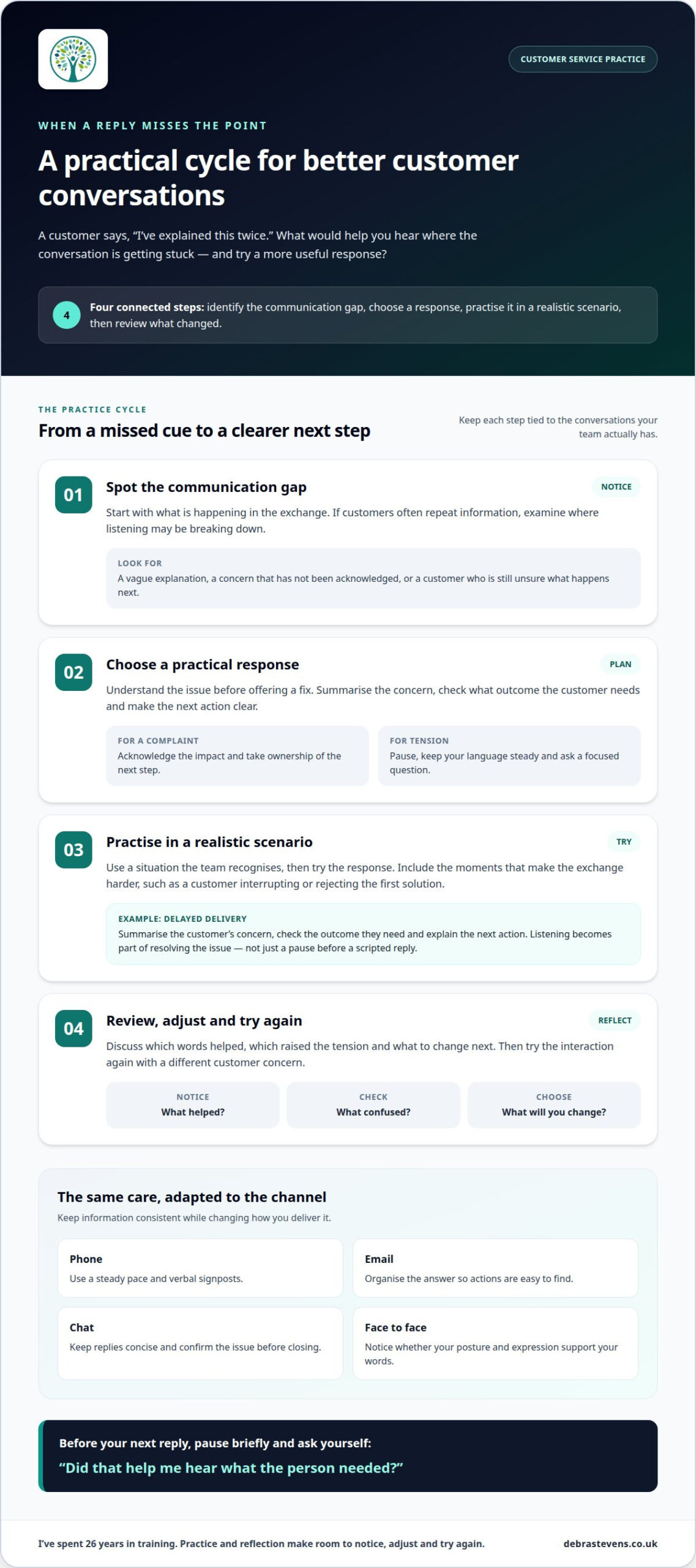
A customer says, “I’ve explained this twice,” and the conversation tightens. Customer service training helps teams practise listening, responding clearly and finding a useful next step in moments like this.
A programme can move from spotting a communication gap to practising a response, applying it and reviewing what happened. I find it useful to make space for each of those steps, so people can notice what’s working and try again.
Handling complaints and conflict
Complaint handling starts with understanding the issue before offering a fix. If a customer reports a delayed delivery, for example, the team member can summarise the concern, check what outcome the customer needs and explain the next action. This makes listening part of resolving the issue, rather than a pause before a scripted reply.
Conflict resolution also means recognising when the first response has missed the point. Training can use realistic complaint scenarios to practise acknowledging the impact, taking ownership of the next step and setting a clear expectation. Look for sessions that let people try again after feedback, rather than simply discuss what a good response might sound like.
De-escalating challenging interactions
De-escalation means lowering tension without dismissing the customer’s concern. In a difficult phone conversation, a team member can pause, keep their language steady and ask a focused question, such as, “What would help resolve this today?” A brief pause before replying can give both people room to reset.
Practise challenging interactions through role-play, including moments when a customer interrupts or rejects the first solution. After each attempt, discuss which words helped, which raised the tension and what to change next. This is more useful than memorising a single phrase, because each complaint will come in different words.
Managing negative reviews
A negative review is a public complaint, so the response needs care as well as clarity. If a review says an appointment was missed, for example, acknowledge the specific concern and explain the next step without arguing point by point. Avoid sharing personal details in a public reply.
Training can help teams distinguish between answering the reviewer and resolving the underlying issue. Practise moving a detailed conversation into an appropriate private channel while keeping the public response measured and respectful. Then use the complaint to identify a process gap, such as unclear appointment updates, rather than treating the review as a one-off exchange.
Communication programme steps
A useful programme follows a sequence: identify the communication gap, choose a practical response, practise it in a realistic scenario, then review what changed. I’d keep the steps simple and connected to the conversations your team actually has, so it’s clear what to practise and what to notice.
If customers often repeat information, for instance, start by examining where listening breaks down. Use a focused exercise, observe the response and give specific feedback. Then try the interaction again with a different customer concern. This cycle turns learning into practice and gives teams a clear way to reflect on their next conversation.
Customer service communication skills
Good customer service combines clear language, careful listening and judgement about what to say next. Build these skills around real interactions, rather than abstract rules.
Professional communication skills
Professional communication means matching your words, tone and level of detail to the customer’s needs. Explain a delivery process plainly, for example, then check that the customer understands the next step. Effective communication can prevent misunderstandings and help break down barriers.
Strong service also means setting realistic expectations and taking ownership of clear actions. A positive team culture makes it easier to share information, so customers do not have to repeat themselves.
Coaching and skills practice
Coaching turns an idea into an observable skill. A team leader might review a sample conversation, identify where an explanation became unclear, then practise a sharper version with the adviser.
Focus practice on a specific gap, such as asking discovery questions before recommending an option. After each attempt, reflect: what helped, what confused the customer, and what will you change? Communication training for customer service teams can build this habit through targeted practice and useful feedback.
Adapting communication across channels
Each channel calls for a different approach. On the phone, use a steady pace and verbal signposts; in email, organise the answer so actions are easy to find. In chat, keep replies concise and confirm the issue before closing the conversation.
Face-to-face interactions also involve posture and expression, so notice whether they support your words. Practise explaining the same policy across all four channels, adapting detail while keeping information consistent. Explore practical communication skills for focused team development.
Risks of poor communication
A vague answer can leave a customer unsure about what happens next. An abrupt tone can make a routine request feel dismissive, while inconsistent explanations may weaken confidence in the information provided.
Sales and influencing skills need care, too. Ask what matters before presenting an option, then explain its relevance without pressure. In a negotiation, clarify expectations and trade-offs; the aim is a workable agreement, not simply a quick yes.
Empathy and active listening
A customer may ask for a refund but need reassurance about what happens next. I encourage you to listen for both the request and the concern behind it, rather than jumping straight to an answer.
Understanding customer perspectives
Give the customer room to explain their situation before deciding what they need. If someone says an online form rejected their details, ask what they tried and what they expected to happen. You might then summarise: “You completed the form, but couldn’t submit it.” This check shows you have listened without assuming you already understand.
Active listening takes more than staying quiet. Notice the customer’s words, ask a focused follow-up question, then check your interpretation. For example, ask, “Have I understood that you need the confirmation today?” Their perspective may differ from your team’s view of the process, so explore that difference before responding to the concern.
Empathy in problem-solving
Empathy can help you choose a response that fits the customer’s circumstances. If someone cannot access an account before an appointment, acknowledge the pressure before explaining the available steps. Then ask what needs attention first. You do not have to agree with every demand to show that you have heard what matters to the customer.
Try this sequence in a practice conversation: listen without interrupting, reflect the concern, ask what outcome would help, then explain the next action. Notice how it lands. Does the customer feel understood, or have you moved too quickly to instructions? Reflect on that difference. Customer satisfaction can be shaped by how clearly people feel heard, as well as by the solution itself.
Managers and leaders can support these communication skills through observation and focused feedback. After a practice interaction, identify one moment where you checked your understanding, then try the conversation again. Keep empathy practical: use the customer’s perspective to guide your next question and make problem-solving more relevant.
Course pricing, certificates and durations
I’d choose a course for the communication gap your team needs to address, not its title alone. Look for practical techniques, relevant situations and time to practise. A focused workshop typically runs 60-90 minutes. Courses can also take a single intensive day or several sessions, giving people more room to apply and reflect on their learning.
Useful training materials make it easier to revisit a skill after the session. A short template, for example, might prompt an adviser to clarify a customer’s issue, explain the next step and check understanding. Make sure materials reflect your team’s actual conversations, rather than relying on scripts that sound stiff or unnatural.
To compare courses, consider the format, practice opportunities and relevance to your customer experience. A course might focus on complaint handling or explaining processes clearly across customer touchpoints. If a certificate matters to you, check what the specific course says it recognises. Certificates and accreditations depend on the programme and awarding body, so do not assume they mean the same thing.
There is no single certificate that applies to every customer service course in the UK. Some training may provide a completion certificate, while formal qualifications or accreditations relate to particular programmes and awarding bodies.
For bespoke team training, the price depends on the format, programme scope, number of sessions and level of tailoring. You receive the price after requesting a quote. These factors also help shape a programme around the time your team can commit and the skills it wants to practise.
If you’d like to talk through a training brief, discuss your team’s training needs.
How I Help You Practise Customer Service Excellence
I help teams practise customer conversations, not just talk about them. I shape customer service excellence training around your organisation’s needs, using realistic situations that reflect the interactions your people handle.
In experiential workshops, professional business actors take part in realistic role-play. You and your team can try a conversation, receive immediate feedback, observe what happened and have another go. The actor becomes part of the feedback process, giving you a chance to practise before it counts.
If you’re looking at broader communication, Communication & Impact Training or Conscious Human Skills Workshops may suit your needs. The Why Factor can also help your team explore what sits beneath your interactions. The right starting point depends on the situations you want to handle with more care and clarity.
If you’d like to explore a training brief, contact me at Debra Stevens Training and Coaching.
Choose the conversation your team wants to change
Pick one customer interaction your team wants to handle differently. It might be explaining a complicated decision, responding to frustration or keeping a conversation clear when the customer is in a hurry. Use that situation as the starting point for communication training for customer service teams, then consider what people need to practise and reflect on.
I find it helpful to connect customer conversations with the wider skills around them. The Why Factor and Conscious Human Skills Workshops can support reflection on how people communicate; Leadership & Management Training can help managers guide practice within their teams. The right focus depends on the conversations and working relationships you want to strengthen.
Start with one question: what would you like your team to try differently in its next customer conversation? If you’re ready to shape that into a training brief, contact Debra Stevens Training and Coaching. A thoughtful first conversation is a good place to begin.
Frequently Asked Questions
Will staff be able to use their new skills immediately?
Staff can start trying a new approach in their next customer conversation. For example, they might replace a rushed explanation with a brief check that the customer understands the next step. Managers can reinforce this by noticing specific behaviours in everyday work and discussing what happened. Immediate use is possible; building confidence comes from continuing to practise, reflect and adjust.
What communication skills should customer service teams be trained in?
Focus on skills that help customers understand their options and take action. These include explaining processes in plain English, asking relevant questions, adapting tone, writing concise messages and handling sensitive information with discretion. A technical support adviser may need to translate specialist terms, whilst a retail colleague may practise explaining a returns process. Match the practice to each role’s conversations and responsibilities.
How much does customer service communication training cost in the UK?
The fee for bespoke training depends on the brief, delivery format, programme development and whether professional actors are included. A quote reflects the scope and design of the work, rather than a standard per-person course price. To plan your budget, first define the team’s learning needs, the situations to practise and the delivery approach you want. Then request a tailored quote.
How do I choose between in-person, online and blended communication training?
Choose in-person sessions when your team needs to practise conversations together and respond to live feedback. Online delivery can suit teams working across different locations or schedules. A blended format combines shared sessions with online follow-up. Debra Stevens Training and Coaching delivers training in-house or virtually, including through Zoom. Let your team’s working pattern and practice needs guide the format.
How long should customer service communication training take?
Choose a duration that gives people time to practise the skill, not just hear about it. A focused workshop typically runs 60-90 minutes; courses may also take a single intensive day or several sessions. Debra Stevens Training and Coaching can deliver bite sized 2-3 hour sessions. Use a shorter format for a specific skill, or spread learning across sessions for continued practice.
How can employers measure the impact of communication training on customer satisfaction?
Choose a small set of indicators before training, such as customer feedback themes, quality reviews of calls or tickets, and whether advisers follow agreed communication steps. Compare the same measures before and after, then discuss examples with the team. A follow-up touchpoint 60-90 days after training can help identify what has transferred into daily interactions and where further coaching may be useful. If you’d like to explore training for your team, I’d be happy to discuss your brief.






One Comment