
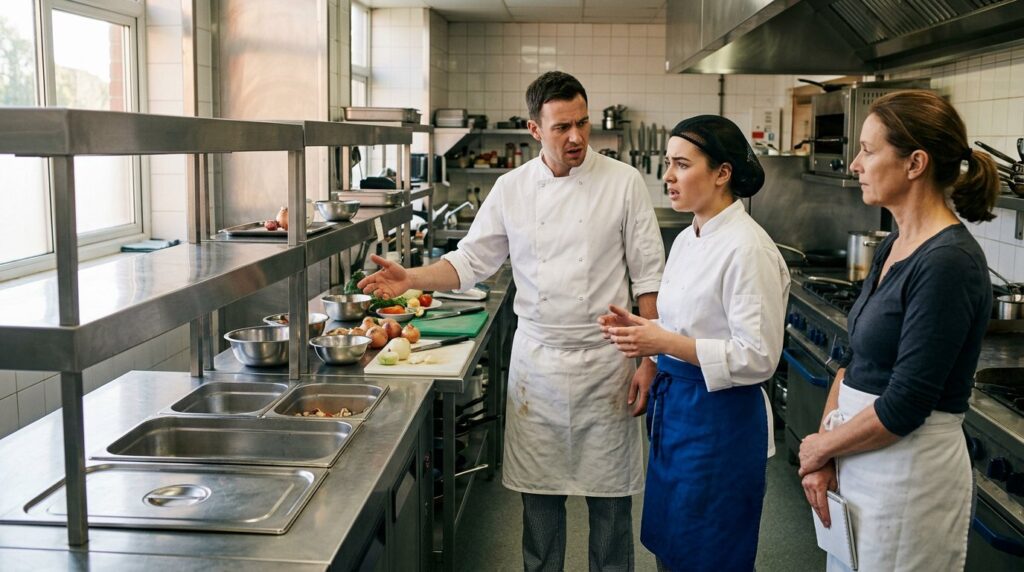
Leadership skills aren’t built through theory alone. Experiential leadership training lets people practise workplace challenges, try different responses and reflect on the results, turning ideas into behaviours they can use at work. Traditional training can explain leadership concepts; experiential learning puts them into action.
Clear frameworks and practical guidance matter. Practice adds space to test those ideas in realistic situations, learn from feedback and build confidence before applying new approaches at work.
This article explains what experiential leadership training involves, how workshops, role-play and feedback help develop leadership skills, and where traditional methods still have a role. It also compares the two approaches, so you can see what each contributes to leadership development.
Key Takeaways
- Use realistic workplace scenarios to practise challenging conversations and leadership decisions in a supportive setting.
- Turn role-play into learning by reflecting on your choices and using constructive feedback to identify what to try next.
- Match the learning method to the goal: practical exercises build applied skills, while traditional teaching can introduce useful concepts and frameworks.
- Explore Conscious Human Skills Workshops when your team wants to strengthen communication, relationships and leadership behaviour through practice.
Experiential workshops and real-time feedback
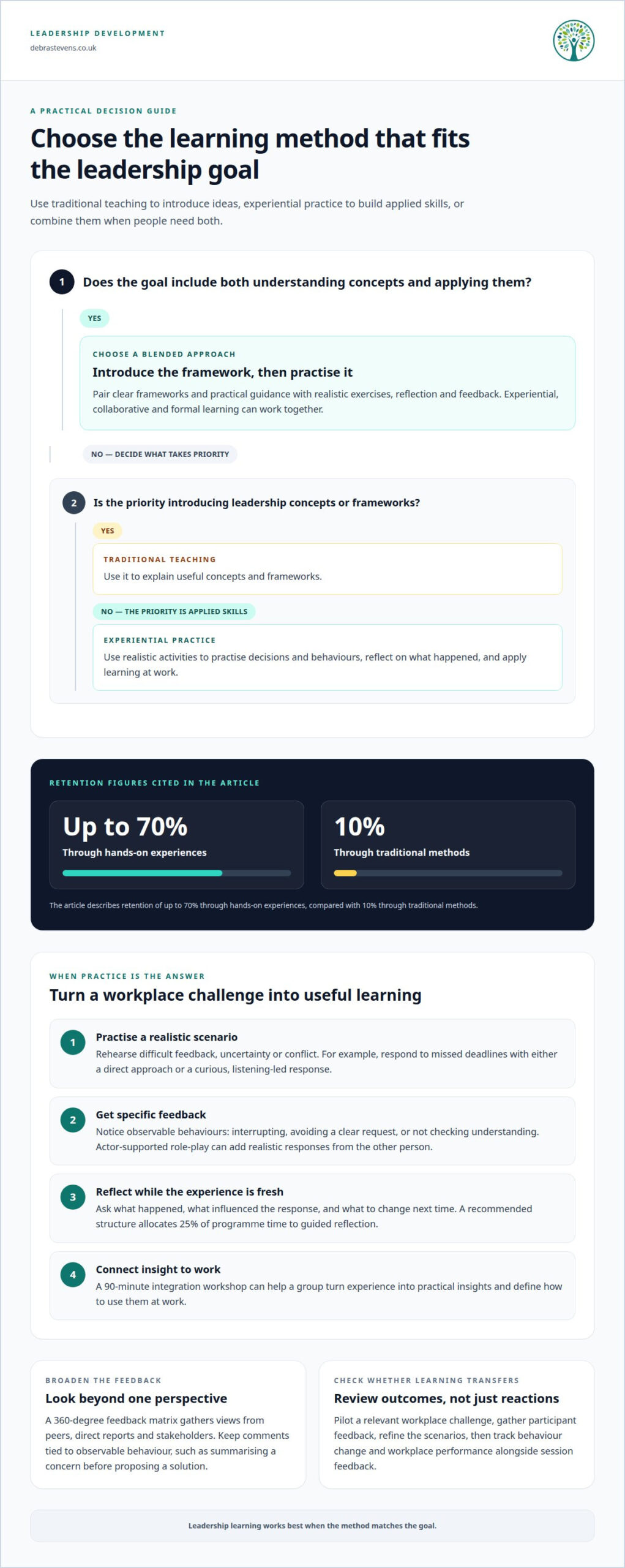
Workshops make leadership behaviour visible. Participants practise difficult feedback, uncertainty or conflict through workplace scenarios, then discuss how their choices shaped the interaction. For example, a manager can rehearse responding to missed deadlines, trying both a direct approach and a curious, listening-led response. The facilitator can pause the scenario, invite another attempt and help participants notice the difference.
Professional feedback turns practice into useful information. A facilitator can identify specific behaviours, such as interrupting, avoiding a clear request or failing to check understanding. Actor-supported role-play can add realistic responses from the other person. Video analysis can also help participants review tone, body language and timing, then compare their observations with feedback from peers.
Build reflection into the session rather than leaving it until later. A recommended structure is to allocate 25% of programme time to guided reflection, with questions about what happened, what influenced each response and what to change next time. A 90-minute integration workshop can help groups turn experiences into practical insights and define how those insights apply at work.
Feedback tools can widen the view beyond the exercise. A 360-degree feedback matrix gathers perspectives from peers, direct reports and stakeholders, helping participants see how their leadership affects different people. Keep comments tied to observable behaviour: “You summarised the concern before proposing a solution” gives clearer direction than a general judgement.
For a wider roll-out, begin with a pilot focused on a relevant workplace challenge. Gather participant feedback after the session, review which scenarios prompted useful discussion and refine the format before scaling. Track changes in behaviour and workplace performance alongside session feedback. This helps distinguish an engaging exercise from learning that influences how people lead.
What Is Experiential Leadership Training?
Experiential leadership training connects leadership ideas with action: participants learn through realistic activities, reflect, then apply lessons at work. Evidence includes retention of up to 70% through hands-on experiences, compared with 10% through traditional methods. Organisations can measure outcomes through feedback, behaviour change and performance measures, linking skills practice with workplace behaviour.
Learning by doing
Learning by doing asks participants to make decisions, not simply hear about them. In a team exercise, they might allocate limited resources, explain priorities and adapt when colleagues raise concerns. This active method shows how communication and judgement shape outcomes. The Scottish Government describes programmes combining experiential, collaborative and formal learning to build aspiring heads’ experience, tacit knowledge and confidence. That mix connects learning with the demands of leading at work, in shared exercises.
Safe experimentation and mistakes
A safe simulation lets leaders test a response without exposing a live team or business decision to the consequences. Participants can try a firm instruction, notice resistance, then practise asking questions instead. Mistakes become material for reflection: what assumption guided the choice, what changed the situation, and what might work better? This helps leaders navigate uncertainty and adapt their response before similar situations arise at work.
Session design and impact measures
Effective session design links preparation, active practice, reflection and workplace action. One suggested allocation gives 20% to context-setting, 40% to active experience and 15% to action planning. Use feedback, behaviour change and performance measures to assess outcomes. After a delegation scenario, assess whether managers clarify ownership in later team discussions. Compare observations with programme goals. For tailored leadership development, explore leadership development through practice around workplace goals.
These programmes give participants practical leadership and team challenges, with space to reflect away from the demands of their work environment. A supportive, invitational environment encourages personal learning, while a controlled setting lets participants try new approaches and learn from mistakes.
Because people learn by doing, activities can reflect workplace challenges such as conflict resolution, crisis management and team dynamics. Exercises also let participants try approaches they may hesitate to use in real life, helping them build confidence for future decisions.
Applying new skills through graduated challenges
Leadership skills become more useful when practice progresses from contained exercises to complex workplace demands. Gradually increasing the challenge helps participants engage, reflect and adapt as situations become more dynamic and pressure rises.
Simulations and role plays
Simulations and role-play recreate leadership situations so participants can practise decisions before facing similar demands at work. A scenario might begin with a team member resisting change, then introduce a missed deadline or conflicting priority. Participants practise listening, setting expectations and explaining decisions. Digital or augmented reality simulations can also represent demanding environments. Each step adds complexity, giving learners a chance to apply skills, reflect on their choices and adjust their approach.
Group and live challenges
Group challenges bring participants together to coordinate action and respond to changing information. For example, a team could plan a service transition while balancing staff concerns, customer needs and limited resources. The exercise reveals how people share responsibility, resolve disagreements and keep decisions moving. Live strategy or transformation challenges bring these dynamics closer to organisational work, helping leaders engage colleagues and test plans against practical obstacles.
Leadership skills and challenges
Graduated practice develops communication, decision-making, adaptability and conflict management through specific leadership challenges. A crisis-management simulation tests how a leader prioritises information, communicates uncertainty and supports a team under pressure. A team-dynamics exercise can expose whose views are overlooked and how inclusive discussion changes the decision. These situations make leadership development tangible: participants can identify the behaviour that helped, the response that stalled progress and the skill to practise next.
Progression matters because a difficult challenge can overwhelm learning if participants lack earlier practice. A facilitator can begin with a clear, bounded task, then introduce competing goals or unexpected changes. This sequence lets participants stretch their judgement without treating one performance as a final verdict. They build a broader repertoire of responses and learn to choose skills that fit the situation, rather than relying on a fixed leadership style.
Experiential versus traditional leadership training
Choose a programme around the team’s goals, workplace culture and leadership challenges, such as managing change. Experiential methods have limits too: simulations need skilled facilitation, time for reflection and opportunities to practise and apply the learning.
Comparing training approaches
Traditional training often introduces leadership theory through presentations or written material, while experiential sessions ask participants to apply ideas in realistic exercises. A briefing on delegation can explain a model; a role-play lets a manager practise assigning work and responding to questions. Neither method has to stand alone. Theory provides a framework, while practice helps participants understand their behaviour and test how well they adapt. A blended approach can make both methods more valuable.
Choosing a programme for a team
Choose a programme by matching its scenarios and learning activities to your team’s priorities. If managers need to lead a restructuring, for example, look for practice around communicating uncertainty, listening to concerns and explaining decisions. Consider whether the format fits the organisation’s culture and goals, and how participants will apply learning afterwards. Coaching or follow-up support can help connect an immersive session with workplace action. A relevant programme should develop skills the team can use, not simply offer engaging activities.
Risks and limitations
Experiential learning can demand more time, space, facilitators and materials than traditional formats. Scaling an immersive workshop across a large organisation may therefore require changes to its design. A generic scenario can also miss the pressures participants face, while an exercise without reflection may leave them unsure what to change. Skilled facilitation helps keep activities relevant and discussions constructive. For practical support in developing leadership capability, explore leadership development options suited to workplace goals.
Debra Stevens Training and Coaching: Conscious Human Skills Workshops
Debra Stevens Training and Coaching uses drama-based, actor-supported scenarios to help leaders practise communication and people skills in realistic workplace situations. Its Conscious Human Skills Workshops help teams strengthen self-awareness, collaboration and the conversations that shape how they work together.
For organisations seeking broader leadership development, Leadership & Management Training can be tailored to their context and goals. Realistic role-play gives participants space to explore different responses, while reflection connects the exercise with everyday leadership challenges. This approach suits teams looking beyond theory to build practical behaviours through active participation.
If your team is ready to develop leadership skills through practice, contact Debra Stevens Training and Coaching to discuss your goals.
Make leadership practice part of what comes next
Choose a leadership behaviour your team wants to strengthen, then make space to practise it in the situations where it matters. That gives experiential leadership training a clear direction, connecting learning with the conversations, decisions and relationships shaping your organisation’s next chapter.
Debra Stevens Training and Coaching offers The Why Factor, Conscious Human Skills Workshops and Leadership & Management Training to support leadership and people skills development. Consider which challenge deserves attention first, whether that means strengthening team relationships or developing leadership capability. A focused conversation can help you explore an approach suited to your goals.
Contact Debra Stevens Training and Coaching to discuss the leadership development your team wants to take forward. Give your people the opportunity to practise, grow and lead with greater intention.
Frequently Asked Questions
Who Can Benefit?
Emerging talent, first-time managers and senior executives can all benefit when activities reflect their responsibilities. A new manager might practise setting expectations with a colleague, while an experienced leader could explore guiding a team through change. Teams can also learn together by examining how different roles influence communication and decisions, then agreeing which behaviours will help them work more effectively.
What activities and methods are used in experiential leadership training?
Experiential leadership training can use role-play, facilitated discussion, team exercises and reflection. For instance, participants might practise chairing a meeting where colleagues disagree about priorities, then consider how they invited contributions and reached a decision. Actor-supported scenarios bring workplace interactions to life, while a facilitator helps participants examine their choices. Activities work best when linked to situations the group actually faces.
How does it compare with classroom-based leadership training?
Classroom-based sessions can introduce shared concepts efficiently, while experiential leadership training gives participants a chance to put those ideas into practice. A short briefing on delegation, for example, can establish a framework; a practice exercise lets managers apply it when assigning responsibilities across a project team. Combining both approaches helps people understand a model and consider how it fits their working relationships.
How long do experiential leadership training programmes last, and what are the steps?
Programme length depends on its goals, format and the learning participants need; sessions can be delivered in bite-sized 2-3-hour formats. The process usually starts by defining workplace priorities and shaping relevant activities. Participants then take part in practice, discuss what they noticed and identify an action to apply at work. Follow-up can review whether that action has influenced their leadership behaviour.