Have you ever left a meeting where everyone seemed to agree, but nobody said what they really thought? A well-designed workshop creates space for honest conversation and helps a team turn it into practical next steps.
Custom corporate workshops for organisations focus on a real team need, not a one-size-fits-all agenda. The subject, activities and scenarios are shaped around the people taking part and the conversations they need to practise. This makes learning active: participants contribute, try new approaches and reflect on their impact.
After 26 years in training, I know that being told what to do is rarely enough. People need space to notice, practise and try again. In this article, I’ll explain what corporate workshops involve, how bespoke training is tailored, and how interactive practice can support engagement, knowledge retention and leadership development. I’ll also share what to consider when shaping a workshop around your team.
Key Takeaways
- Build a workshop around a real team need, using creative activities to help people explore problems and develop ideas together.
- Shape the design, delivery and evaluation around clear objectives, participant needs and opportunities to improve.
- Make participation active through discussion, practice and reflection so people can connect learning with their work.
- Use realistic scenarios and supported practice to develop leadership skills and prepare for important conversations.
What Is a Corporate Workshop?
UK organisations can choose creative, wellbeing, artist-led, experiential or problem-solving workshops. I’d start with the objective: perhaps your team needs to explore ideas, strengthen focus or practise a difficult conversation.
A workshop gives employees a chance to contribute, not just listen. For example, participants could map a customer journey and identify where a handover becomes unclear. Custom corporate workshops for organisations can tailor activities to the team’s roles, relationships and objectives.
Artist-led creative workshops use activities such as drawing, storytelling or improvisation to explore workplace themes. An artist might invite participants to create a picture of effective teamwork, then discuss what its parts represent. This can help people express thoughts they might find harder to raise in a meeting.
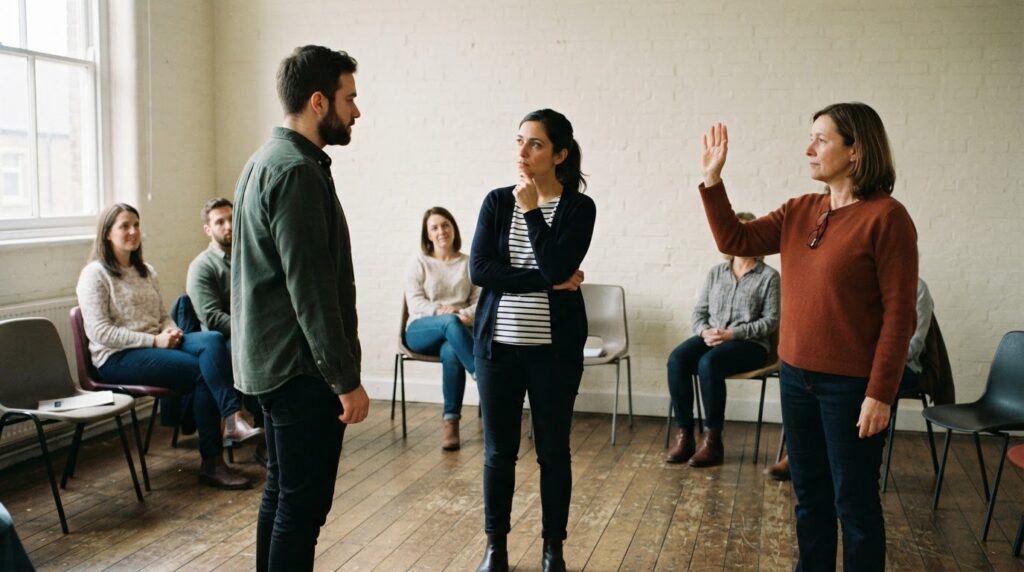
Experiential workshops turn an idea into something participants can try. Small groups, for example, could act out different responses to a workplace scenario, then reflect on what happened. Professional actors can make scenarios feel realistic and contribute feedback, rather than simply provide entertainment.
A creative problem-solving session focuses a group on a defined issue and a practical outcome. Your team might identify a recurring process frustration, sketch possible fixes, then present a proposed change. Design thinking activities can help participants explore the issue before settling on a response.
For employee wellbeing, creative activities might include guided drawing, reflective writing or group storytelling. These give participants a structured way to pause, notice their responses and share experiences. Choose activities that serve the session’s objective, rather than adding them for novelty.
To plan and book a custom workshop, define the objective and the workplace situation it should address. Agree who needs to take part, what they should practise, and whether the session will be in person, online or hybrid. Then settle the date and venue, share relevant context with the facilitator, and shape the activities around the group.
What Exactly Defines Bespoke Corporate Training?
I shape bespoke training around a workplace need, not a ready-made agenda. Bring the objective, and I’ll help turn it into practical learning that fits your employees.
Training design and delivery
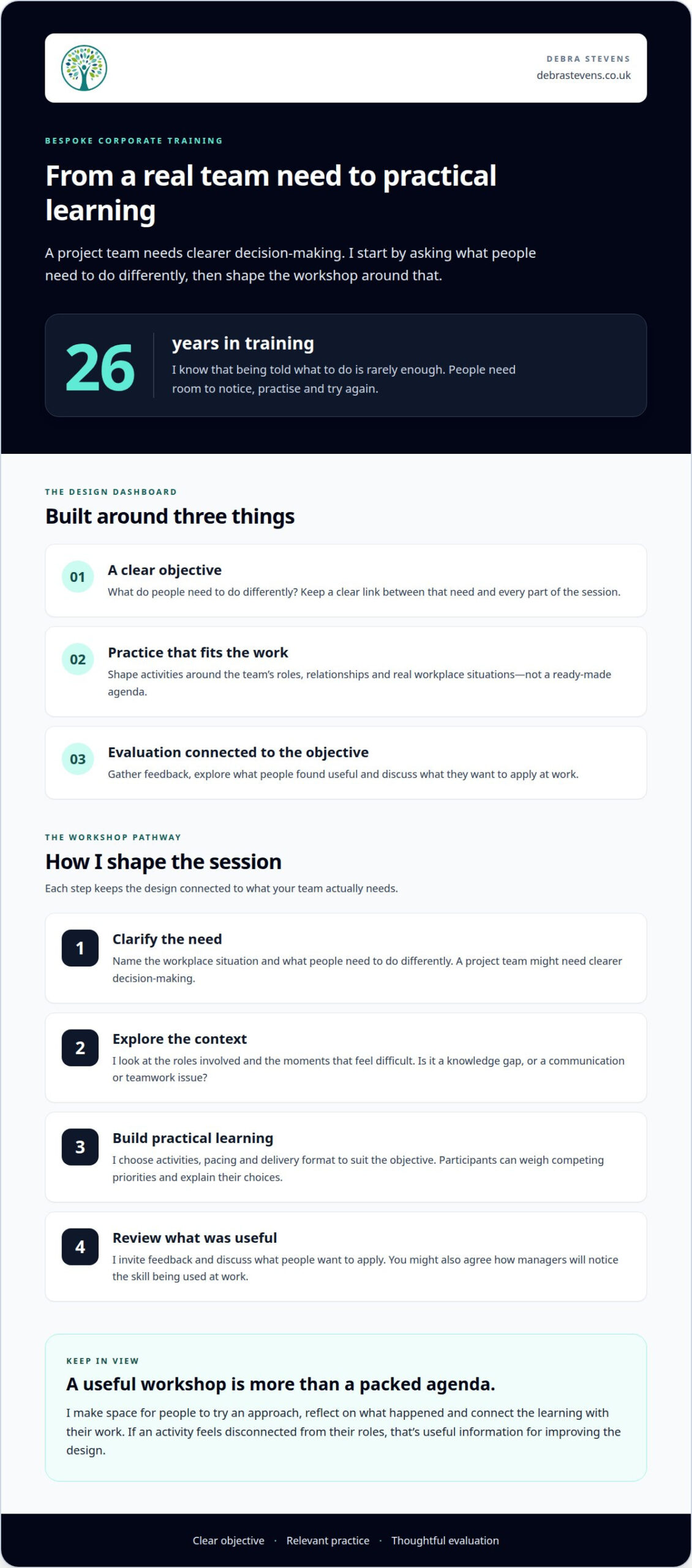
I begin by clarifying what people need to do differently, then build the session around that objective. The design considers activities, pacing and delivery format. If a project team needs clearer decision-making, for example, I might create an exercise where participants weigh competing priorities and explain their choices. Look for a clear link between the stated need and every part of the session.
Expert-led training design
A skilled designer can help distinguish a knowledge gap from a communication or teamwork issue. I explore the context with you, including the roles involved and the moments that feel difficult. That helps me choose a useful approach rather than simply add more content. A proposal should explain why its activities suit your team’s actual work.
Design thinking can help a team examine a complex challenge before jumping to solutions. I guide participants to describe the issue, consider different viewpoints, generate possible responses and test an idea. A team planning a new internal process, for example, could map the steps from an employee’s perspective, then identify where confusion may arise. This makes collaboration purposeful and gives innovation a practical starting point.
Evaluation should connect to the objective. I can gather participant feedback, explore what they found useful and discuss what they want to apply. If an activity feels disconnected from people’s roles, that’s useful information for improving the design. You might also agree how managers will notice the skill being used at work. This makes evaluation a conversation about learning and next steps, not just whether people enjoyed the session.
If you’re shaping a programme around a specific need, bespoke workshop design can help connect your objective with relevant practice.
Benefits for engagement and knowledge retention
Participants are more likely to contribute when activities connect with their work. A clear purpose, varied opportunities to practise and time to reflect can help employees stay engaged.
Participant engagement activities
Use activities that give everyone a way into the discussion. Invite participants, for example, to write a response to a workplace dilemma before sharing in pairs. This gives quieter employees thinking time and reduces the pressure of speaking first. In a hybrid session, give remote colleagues the same prompt and a clear way to contribute. Notice whether hierarchy or group dynamics are limiting participation.
A short sequence can keep energy focused: introduce a realistic situation, ask small groups how they would respond, then compare their choices. Teams might consider how to raise a concern when a deadline is at risk. Make space for different perspectives, including how stress may affect someone’s response. The aim is not forced agreement, but useful discussion and confidence to speak up.
Training effectiveness
Engagement supports learning when participants actively recall and use an idea, rather than only hearing it. After introducing a communication technique, ask people to explain it in their own words, practise it, then reflect on what they would change. This gives employees a chance to connect new knowledge with a real workplace situation.
Keep presentations brief and leave room for participation. A session filled with slides can make employees observers; discussion or practice invites them to test their understanding. Learning also needs a route back to work. Ask each participant to choose a conversation or task where they’ll try the approach, then revisit what happened in a follow-up discussion.
Engagement doesn’t mean constant activity. Build in pauses for reflection, especially when a topic involves stress or difficult relationships. When people can take part without being put on the spot, they can explore ideas, question assumptions and contribute to innovation. Ask yourself: who has spoken, who hasn’t, and what would make the next activity easier to join?
Leadership development
Corporate workshops can explore leadership, wellbeing, team building and communication. Begin with the workplace moment your people want to handle differently.
Inclusive leadership training
Inclusive leadership training can help managers notice whose voices are heard and whose ideas get missed. I might use a scenario where one colleague is interrupted while another dominates a discussion. Participants can practise stepping in, inviting the quieter person to contribute and listening without rushing to respond. Choose exercises that help leaders reflect on their impact, not simply learn terminology.
Leadership and management skills
Workshops can build practical skills in delegation, feedback, decision-making and difficult conversations. A manager might practise explaining a change, listening to concerns and agreeing a clear next step. The learning should fit participants’ responsibilities. A new manager, for example, may need to practise setting expectations, whilst an experienced leader may want to explore how they respond to challenge.
Workshop topic selection
Choose a topic by naming a specific workplace moment. Are managers avoiding a difficult conversation? Does a team need to work through tension or build trust? Wellbeing sessions can focus on supportive conversations, while team-building activities can explore how colleagues collaborate. I shape exercises around the objective, so participants can connect the learning with situations they recognise.
Storytelling can help leaders make a message more human. I might ask a manager to describe a time their team adapted to change, then explore which actions mattered. Participants can practise telling that story clearly and consider what colleagues need to hear. It encourages reflection without asking anyone to memorise a polished speech.
To explore leadership workshop training, bring me a conversation your managers need to handle well.
How I can help with customer service excellence
I can help when your team needs to turn customer service principles into confident, practical conversations. In Customer Service Excellence workshops, I shape the learning around situations employees face, such as responding to a complaint or explaining a difficult decision.
My approach is experiential. Participants practise realistic workplace conversations, reflect on how their words land, and try again. Where useful, professional actors help create realistic scenarios and contribute to the feedback. It’s a chance to learn before the conversation really counts.
If your focus is broader, The Why Factor and Conscious Human Skills Workshops explore the human side of working together, while Leadership & Management Training supports managers as they develop their skills. The right starting point depends on the conversations or behaviours you want to explore with your team.
If you’d like to discuss a training brief, contact me.
Choose the conversation your team is ready to practise
Before planning another session, identify one moment at work you’d like to handle differently. Perhaps a decision needs clearer explanation, a concern deserves a better response, or a team conversation keeps going round in circles. Start there. A specific moment gives people something real to explore, rather than another abstract idea to remember.
A plan for custom corporate workshops for organisations can grow from that example. I begin by asking what currently happens, what you’d like to happen instead, and who needs to be part of the conversation. This gives the workshop a useful direction while leaving room to learn from what participants notice and practise.
You don’t need to arrive with a polished brief. Bring the situation that’s on your mind, and we can explore what kind of learning might fit. Talk through your training brief with Debra Stevens Training and Coaching. A thoughtful first conversation can be a good place to begin.
Frequently Asked Questions
Do you offer digital or hybrid workshop options?
Delivery options can be discussed when planning your brief. We can consider what would suit the session’s purpose and participants, including how colleagues in different locations might contribute. For example, shared prompts can help invite responses from people in the room and online. The right approach depends on the brief.
Do you offer repeat bookings or packages?
Repeat sessions can be arranged as bite sized 2-3 hour sessions over an agreed time frame. This can help teams revisit a theme or bring learning to different groups, rather than asking everyone to attend one long event. The sequence can be shaped around your organisation’s objectives. When planning, share the intended schedule and which employee groups need to take part.
What are the costs?
Fees depend on the brief rather than a single standard rate. The price reflects the work involved in developing and facilitating the sessions, including the focus, format and whether professional actors are part of the learning design. Share your intended outcomes and delivery requirements when requesting a quote. This gives the fee a basis in your organisation’s specific needs.
How do you tailor a corporate workshop to an organisation’s goals and employees?
For custom corporate workshops for organisations, I start by understanding the outcome you’re working towards and the situations employees face. A team preparing for a service change, for example, may need to practise explaining it to customers, while managers may need to respond to staff concerns. I use that context to shape scenarios, activities and reflection around the people taking part.
What is the typical cost of a bespoke corporate workshop in the UK?
The cost of a bespoke workshop in the UK depends on its brief, so a single typical figure would not describe every programme. A focused session and a programme involving more scenario development or professional actor support have different design and delivery requirements. The format and intended outcomes matter too. Request a quote based on the scope you have in mind for your organisation.
What factors affect corporate workshop pricing, duration and group size?
Pricing reflects the design and facilitation involved, the session format and any professional actor support. Duration depends on the learning objective, activities, and how much time participants need to practise and reflect. Group size affects opportunities to contribute and receive feedback. For a larger team, the design may use smaller groups so everyone can take part meaningfully.






One Comment