

A quiet meeting doesn’t always mean a team is working well. Psychological safety at work means people feel able to ask questions, raise concerns and admit mistakes without fear of humiliation or blame. Effective psychological safety in workplace training helps teams practise these behaviours and see how leaders, managers and everyday processes can make speaking up easier.
Most people know trust matters. The challenge is turning that principle into consistent actions, especially when deadlines are tight, opinions differ or something goes wrong. A supportive culture isn’t built by simply telling people to speak up. It depends on how others respond when they do.
This article explains what psychological safety looks like at work and why it matters. It covers the everyday behaviours that encourage open discussion, the role of organisational processes and practical ways to help teams learn from concerns and mistakes. The goal is to build working relationships where people can contribute honestly and tackle challenges together.
Key Takeaways
- Make it easier to raise concerns by responding with curiosity, respect and a clear next step.
- Look beyond individual relationships: workplace processes also shape whether people feel safe to speak openly.
- Use everyday conversations to invite questions, learn from mistakes and bring quieter perspectives into the discussion.
- Help managers build practical habits that turn the intention to listen into a more open team culture.
Trust in leaders, managers and organisational processes
Trust grows when leaders listen, explain decisions and act on feedback. Training can help develop these habits among senior leaders, managers, HR teams, occupational health professionals and employees.
In Dräger’s Safety and Health at Work 2025 research, 30 per cent identified a lack of supportive leadership as a factor in low psychological safety.
Listening, communication and leadership commitment
Build listening into regular team conversations. Leaders can ask what is getting in the way, invite quieter colleagues to contribute and explain what action will follow. Authentic communication means acknowledging uncertainty and giving clear reasons for decisions, rather than promising changes that may not happen.
Training should give senior leaders, managers and teams distinct practice. Senior leaders can examine how policies and reporting processes shape trust; managers can practise responding to feedback; HR and occupational health teams can consider how staff concerns are received and followed up. The Center for Creative Leadership’s study included nearly 300 leaders, and found significant variation in perceived psychological safety across 62% of senior teams. Use those findings as a prompt to gather feedback within your own organisation, not as a score for an individual team.
Responding to mistakes and difficult questions
UK workplace health and safety guidance for social work settings calls for supervisors to be trained and supported to lead reflective, analytical discussions. Employer standard 5 is the supervision standard. Supervisors also need protected time to examine dilemmas and defensible decisions. This is practical guidance for social work, not a universal training rule for every UK workplace.
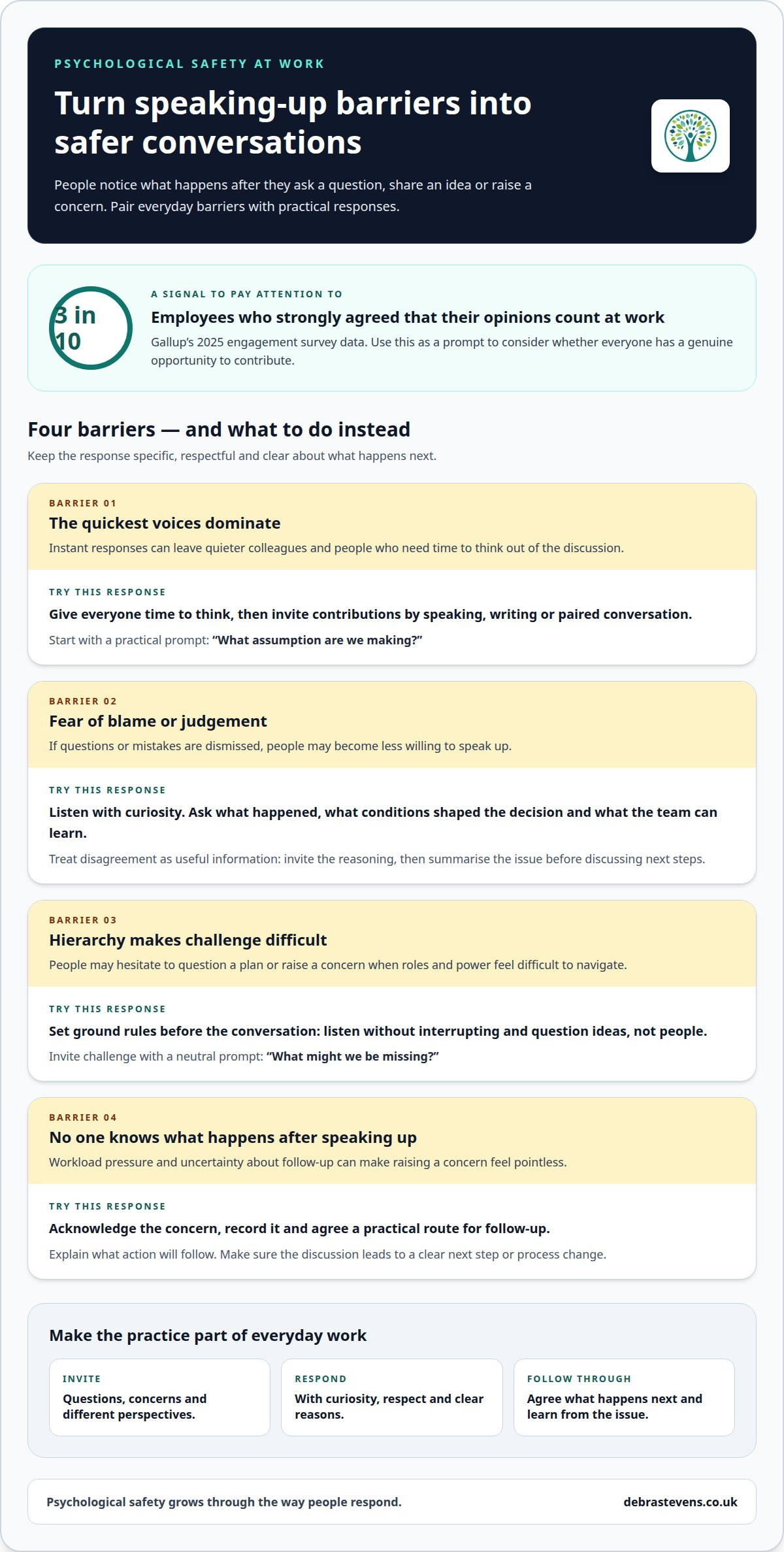
When mistakes happen, ask what occurred, what conditions shaped the decision and what the team can learn. Treat disagreement as useful information: invite the person to explain their reasoning, then summarise the issue before discussing next steps. If someone raises a difficult question, acknowledge it and agree how it will be addressed. Avoid blame or dismissal, which can discourage people from speaking up. Make sure the discussion leads to a process change or clear follow-up action, rather than ending there.
What Is Psychological Safety at Work?
Psychological safety means employees can contribute, ask questions and flag concerns without fearing humiliation. At Harvard Business School, Amy Edmondson’s research on the topic spans over 20 years. Earlier, MIT professors Edgar Schein and Warren Bennis explored the term in 1965, linking it with people’s ability to adapt to organisational change.
Psychological safety supports performance by making learning part of everyday work, not a substitute for high standards. Google’s Project Aristotle identified psychological safety as the most important factor in team effectiveness. In practice, a team can expect accurate work while still inviting an employee to question an assumption before a decision is final. Standards stay high, while people have room to flag risks and improve their approach.
How can organisations measure psychological safety in workplace training? Gather confidential employee feedback and compare it with observable behaviours, such as whether people ask questions, share concerns and discuss errors. Review the same signals after training, then use the findings to decide what managers should develop next.
Performance management can reinforce this learning. Managers should give feedback on specific actions, describe their effect and agree a practical next step. After a missed handover, for example, coaching can explore what information was unclear and how the process could improve. Human and Organisational Performance applies this focus to systems and working conditions, rather than treating an individual mistake as the whole problem.
Wellbeing and retention also deserve attention in performance conversations. A manager can ask whether workload, unclear priorities or team communication are affecting an employee’s ability to contribute. McKinsey research cited on psychological safety found 89 per cent of respondents believed it encourages greater innovation and a stronger community. Managers seeking practical ways to build these conversations can explore Leadership & Management Training.
Building a workplace culture where people can speak up
Speaking up takes more than an invitation. People notice how questions, ideas and concerns are received. Training can help teams practise participation before applying those skills to everyday work.
Speaking up, questions and ideas
Begin with a practical prompt, such as asking participants to identify an assumption in a proposed plan. Give everyone time to think, then invite contributions in different ways: speaking, writing or paired conversations. This eases the pressure to respond instantly and helps facilitators hear more than the quickest voices.
Make challenge part of the exercise. Ask, “What might we be missing?” and respond to each suggestion with curiosity rather than judgement. In Gallup’s 2025 engagement survey data, 3 out of 10 employees strongly agreed that their opinions count at work. Use that finding to examine whether training gives every participant a genuine opportunity to contribute.
Facilitating participation and raising concerns
Set clear ground rules before a session: listen without interrupting, question ideas rather than people, and explain how concerns will be handled. For example, a participant raising a risky handover can describe the issue, its potential impact and the process that needs review. The facilitator should record the concern and identify a practical route for follow-up.
Barriers include workload pressure, fear of blame, hierarchy and uncertainty about what happens after someone speaks. In Dräger’s Safety and Health at Work 2025 research, 48 per cent identified high workload or time pressures as a factor contributing to low psychological safety. A training activity can surface these obstacles, but organisations also need to address the working conditions behind them.
Impression management and barriers to speaking up
Impression management is the effort to protect how others see you. During training, an employee may hide confusion, avoid challenging a senior colleague or agree publicly to appear capable. Ask participants to consider a realistic scenario privately before sharing, and make clear that thoughtful disagreement is part of the exercise.
Common barriers during workplace training include unequal status, emotionally charged topics and concern that mistakes will affect someone’s reputation. Dräger’s 2025 research found 65 per cent of workers believed a lack of psychological safety contributed to workplace safety risks. Review who speaks, whose concerns receive follow-up and whether quieter participants have meaningful ways to contribute.
Manager behaviours that support psychological safety
Managers shape team climate through small, repeated choices. In a one-to-one, ask what feels difficult before offering a solution. Listen without interrupting, then check that you have understood the concern. This shows team members that raising an issue leads to attention, not automatic judgement. Follow through on agreed actions, or explain clearly if circumstances change.
Respond to mistakes with a learning-focused review. Ask what information was available, what pressures affected the decision and what might help next time. Separate the person from the process: a missed handover, for example, may point to unclear responsibilities rather than carelessness. Managers can acknowledge the impact while keeping standards clear. This balance helps people learn safely and supports improvement without excusing harmful behaviour.
For diverse and remote teams, make participation accessible: invite questions in writing, pause after asking them and seek views from people who have not spoken. In video meetings, share the topic beforehand and use a chat or shared document alongside discussion. Managers should also challenge exclusionary comments respectfully and make space for the emotional impact of difficult conversations. These practices help people participate across different communication styles and working arrangements.
In UK social work, supervision guidance highlights compassionate curiosity, open-ended questions and space for reflection. Managers can adapt these practices by asking, “What might we be missing?” and exploring different perspectives before making a decision. Anti-racist practice also means considering how racism may affect employees psychologically. Managers should consider whose voices shape decisions, who receives feedback and whether concerns lead to action.
Put these behaviours into practice through Leadership & Management Training, with scenarios that help managers rehearse responses to mistakes, challenge and sensitive team conversations.
Debra Stevens Training and Coaching: The Why Factor
Debra Stevens Training and Coaching helps teams turn psychological safety principles into practical communication and leadership behaviours. The Why Factor and Conscious Human Skills Workshops use experiential learning and professional actors in realistic role-play scenarios. Participants can practise speaking up, listening and responding in the moment.
This support can help when teams understand the value of openness but struggle to apply it during disagreement, change or everyday pressure. Leadership & Management Training helps managers strengthen the habits that shape team conversations, while bespoke programmes can be tailored to an organisation’s needs.
Contact Debra Stevens Training and Coaching to discuss a practical next step for your team.
Make speaking up part of how your team works
Choose a meeting, handover or review where people could contribute more openly. Agree a simple practice, such as inviting a different perspective before decisions are final, then notice how the team responds. Focus on observable actions rather than labelling people as confident or difficult. This gives managers a practical starting point and helps teams build habits through everyday work.
Psychological safety in workplace training can support this shift when it connects directly to your organisation’s real conversations and challenges. Debra Stevens Training and Coaching offers The Why Factor, Conscious Human Skills Workshops and Leadership & Management Training to help teams practise communication and leadership skills in context.
To explore an approach that fits your team, contact Debra Stevens Training and Coaching. A more open working culture grows through consistent actions, and your next conversation can be a useful place to begin.
Frequently Asked Questions
How is it delivered?
Delivery can be tailored to the organisation, with sessions held virtually or face to face. Debra Stevens Training and Coaching offers in-house training in bite-sized 2-3 hour sessions. Facilitators use dramatic techniques, including professional actors, to bring workplace situations to life. For example, a team can explore a challenging conversation through a realistic scenario, then reflect on what different responses make possible.
What is psychological safety in workplace training?
Psychological safety in workplace training means people can take part in learning without fearing ridicule or personal embarrassment. It doesn’t mean every contribution is correct or every decision is agreed. A useful sign is whether someone can say, “I’m not sure I understand this process,” and receive a constructive explanation. Training gives people a chance to practise that exchange before similar moments arise at work.
What are the benefits of psychological safety for workplace learning and performance?
It helps employees share useful information earlier, including uncertainties that might otherwise remain hidden. In a project review, for instance, a team member might flag an assumption before it shapes the final plan. Colleagues then have more opportunity to examine options and adjust their work. Learning becomes more active too: participants can test ideas, compare approaches and use feedback to improve their next attempt.
How can trainers create psychological safety in workplace training sessions?
Set expectations at the start: explain the session’s purpose, how participation works and how personal examples will be handled. Offer different ways to contribute, such as speaking, writing a question or discussing an idea with a partner first. If a participant opts out of an exercise, don’t put them on the spot. Invite feedback during the session and adjust the pace or format where practical.
What practical activities help build psychological safety in training?
Try a perspective-switch exercise: participants consider a workplace scenario from the viewpoints of the people involved, then identify what each person needs to speak openly. Or use a “what would you ask?” prompt, where everyone writes a question before group discussion begins. These activities give quieter participants time to think and help the group explore assumptions without making one colleague the focus.
How can psychological safety be balanced with accountability and constructive challenge?
Make the expected standard clear, then discuss actions and their effects rather than judging someone’s character. If a team member misses an agreed handover, clarify what was expected, explore what interrupted it and agree how future handovers will be completed. Invite colleagues to challenge the proposed solution with reasons and evidence. Supportive discussion and accountability work together when commitments remain visible and follow-up is consistent.
One Comment