

A leadership keynote speaker in the UK should do more than fill a slot in your programme. Choose someone who can focus attention on a real leadership challenge and give your audience ideas to discuss and apply. The value depends on matching the speaker’s experience and style to your event’s purpose.
A compelling speaker can energise a room, but finding someone who connects with your audience and moves the conversation beyond inspiration takes care. A speaker bureau can help coordinate a shortlist and booking; booking directly means liaising with the speaker or their representatives.
This guide explains why organisations book leadership keynotes, how to choose a speaker for a UK event, and what to consider when deciding between a bureau and a direct booking. You’ll also learn how to align the keynote with your programme, audience and desired outcomes, so you can make a confident choice.
Key Takeaways
- Set a clear event goal first, then look for a speaker whose experience and style suit the audience.
- Plan the enquiry around your event date, format and budget to make the booking process more focused.
- Compare the practical differences between booking directly and using a bureau, including the coordination each route involves.
- For leadership development beyond a one-off keynote, explore learning formats that help teams practise new skills.
Should you book through a speaker bureau or directly?
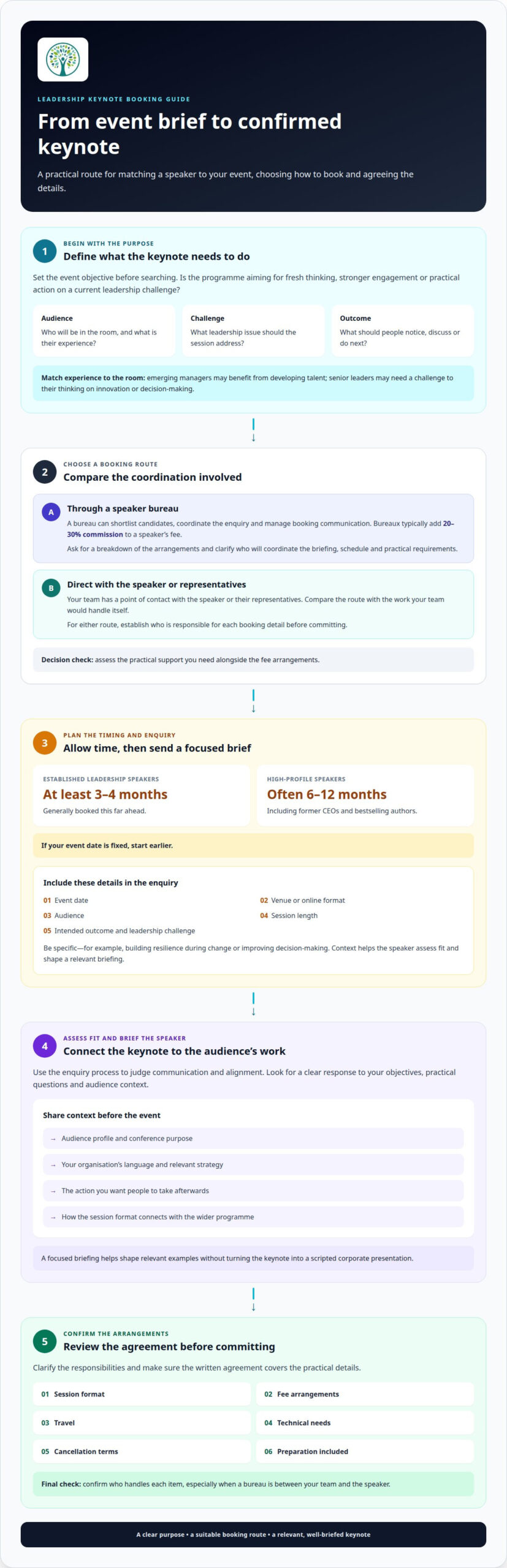
For a corporate event, choose the booking route that fits your planning needs. A speaker bureau can shortlist candidates, coordinate the enquiry and manage booking communication. Direct booking gives your team a point of contact with the speaker or their representatives. Compare what each route covers before deciding.
Speaker bureaux typically add a 20-30% commission to a speaker’s fee. Ask for a breakdown of the booking arrangements, then compare it with the work your team would handle directly. For example, if your event needs a motivational speaker and a tailored session, establish who will coordinate the briefing, schedule and practical requirements.
How far ahead should you book? Established leadership speakers are generally booked at least three to four months ahead. High-profile speakers, including former CEOs and bestselling authors, often book six to twelve months ahead. Start earlier if your event date is fixed.
Send a focused enquiry with the event date, venue or online format, audience, session length and intended outcome. Describe the leadership challenge, such as building resilience during change or improving decision-making. This context helps the speaker assess fit and shape a relevant briefing, rather than relying on a generic motivational talk.
Before committing, review the written agreement and clarify the session format, fee arrangements, travel, technical needs, cancellation terms and preparation included. Confirm who handles each item, especially if a bureau is between your team and the speaker. Agree on the briefing process and share relevant context, such as your organisation’s strategy or the audience’s experience. Credibility matters, but so does the ability to connect big-picture ideas with people’s day-to-day work.
Use the enquiry process to assess communication and alignment. A clear response to your objectives, practical questions and audience context helps you decide whether direct contact or bureau support better suits your needs.
Why Book Keynote Speakers For Your Event?
A keynote earns its place when it changes what an audience notices, discusses or does next. Set the event objective first: does your leadership conference need fresh thinking, stronger engagement or practical action on a current challenge? Then choose a speaker whose experience supports that outcome. A founder might speak about building an organisation, while a former executive can draw on decisions made at scale.
Which UK leadership speakers focus on change, innovation or resilience? Brendan Hall’s leadership story from a 40,000-mile ocean race can prompt discussion about adapting under pressure. Margaret Heffernan, who has been a CEO five times, offers another perspective on leadership and organisational change.
Match the speaker’s examples to the audience’s work. For emerging managers, a session on developing talent may be more useful than a high-level strategy talk. For senior leaders, look for a speaker who can challenge assumptions about innovation or decision-making. If success means stronger selling conversations, choose someone who can connect leadership behaviour with how teams engage customers. Inspiring stories create a spark; relevant ideas give people something to apply.
Brief the speaker before the event. Share the audience profile, conference purpose, language your organisation uses and the action you want people to take afterwards. If teams are facing restructuring, for example, explain what has changed and where leaders need to build trust. Agree on the session format and how it connects with the wider programme. A focused briefing helps the speaker shape relevant examples without turning the keynote into a scripted corporate presentation.
Keep budget decisions tied to the event’s priorities. Consider the speaker’s fee alongside travel, the session format, preparation and any technical or programme requirements. Compare those factors against the value you need: a memorable opening, a challenge to established thinking or practical tools for leaders. If the goal extends beyond a single event, leadership and management training can help teams develop ideas through continued practice.
Finding keynote speakers in the UK
Start with a search brief built around your event format and leadership challenge. For example, a UK organisation planning a change conference may need a speaker whose work centres on leading through uncertainty. A directory of change leadership keynote speakers available to UK organisations in 2026 can provide a starting point, but topic labels alone won’t show whether a speaker suits your culture.
Look beyond directory profiles. Review the speaker’s website, published talks, books and previous conference appearances. An author who writes about organisational change may offer useful depth, while a speaker with experience inside a global business might share relevant examples of transformation at scale. Compare their work with the questions your audience needs to explore.
Ask colleagues who organise leadership events for recommendations, then assess each suggestion against your needs. A speaker who worked well at another organisation’s annual meeting may not suit your executive conference. Consider whether the format, tone and level of detail fit your event. A short keynote, an interview and an interactive session each make different demands on the speaker and audience.
A speaker bureau can suggest names around a particular theme or sector. Give it a clear description of your audience, event purpose and preferred format, rather than asking for a broad list of famous speakers. For example, specify whether you need practical examples for new managers or strategic discussion for senior leaders. A focused brief makes recommendations easier to assess.
Build a shortlist by recording each speaker’s central message, relevant experience, delivery style and fit with your programme. Watch a full talk where possible, not just a highlight reel. Notice how the speaker handles questions, explains complex ideas and connects stories to action. Then compare the strongest candidates with your event’s culture and the role their session needs to play. This gives your team a reasoned basis for choosing, rather than relying on name recognition alone.
Which UK leadership speakers specialise in executive and C-suite audiences?
For senior teams, look for speakers who understand organisational scale, board-level decisions and the pressure of leading through change. Chris Hirst led more than 10,000 people as Global CEO of Havas Creative Group. His executive experience can give a C-suite audience a grounded perspective on leadership across a large organisation.
Hirst was shortlisted for Campaign Magazine’s Global CEO of the Year in 2022. That recognition adds context to his profile, but your event’s needs should guide the choice. If the priority is strategy, consider what a speaker can contribute to the specific decisions facing your leadership team.
Retail leaders can offer another useful lens. Archie Norman has been Chairman of M&S since 2017, bringing experience relevant to discussions about corporate leadership and organisational direction. Andrew McMillan’s 28 years at John Lewis may suit an audience exploring leadership within a major retail organisation. Allan Leighton’s experience includes selling ASDA to Wal-Mart, a significant example of business change.
Different backgrounds bring different strengths. A board retreat focused on strategic direction may benefit from a former chief executive’s decision-making experience. A leadership conference about customer-facing culture may find retail experience more relevant. Match the speaker’s work history to the challenge your executives need to tackle, then consider whether their delivery style suits a candid discussion or a formal keynote.
Use a focused selection process: define the executive audience’s central question, identify the experience that can illuminate it, then review the speaker’s talks and published work. Ask how their examples will connect with your organisation, not just how impressive their biography sounds. A leadership team preparing for restructuring, for instance, may need insight into communicating change, while a board reviewing growth plans may value experience shaping organisational strategy.
A keynote can open the discussion; sustained development helps leaders put ideas into practice. Explore ways to build executive leadership capability when your event needs to lead into continued learning.
Debra Stevens Training and Coaching: The Why Factor
When a keynote raises questions about leadership and behaviour, Debra Stevens Training and Coaching’s The Why Factor offers a way to explore them further. Its experiential approach uses realistic workplace role-play with professional actors, helping participants examine how they respond in real-world situations.
Choose Leadership & Management Training when managers want to strengthen their leadership practice, or Conscious Human Skills Workshops when the focus is on interpersonal skills that shape collaboration. Programmes are tailored to organisational needs, connecting learning with the challenges your people face.
If your event has prompted a practical conversation about what should change next, explore the options at Debra Stevens Training and Coaching.
Carry the conversation into everyday leadership
A strong event can open a useful conversation, but the next step is deciding what people should do differently when they return to work. Choose a leadership challenge to carry forward, then make space for teams to discuss and practise their responses. Invite managers to bring a current work challenge so learning connects with real decisions and relationships.
For continued development, Debra Stevens Training and Coaching offers The Why Factor, Conscious Human Skills Workshops and Leadership & Management Training. These programmes help teams explore workplace behaviour, strengthen human skills or build management practice beyond a single event.
A leadership keynote speaker in the UK can spark fresh thinking; follow-through can keep that conversation active across your organisation. Contact Debra Stevens Training and Coaching to discuss a suitable next step. Keep moving forward with leadership your people can put into action.
Frequently Asked Questions
Who are the best leadership keynote speakers for UK events?
The best choice depends on your audience and event purpose, rather than a single ranking. For a sporting perspective on team performance, Sir Clive Woodward led England to Rugby World Cup victory in 2003. Kate Richardson-Walsh captained Great Britain’s women’s hockey team to Olympic gold at Rio 2016. Compare each speaker’s experience with the leadership challenge your UK audience wants to explore.
Can leadership speakers customise their talk for your industry?
Yes, a keynote can be shaped around your industry, audience and current priorities. Give the speaker concrete context, such as a new operating model, a customer experience challenge or a merger affecting team roles. Ask for examples that connect leadership ideas with your sector’s day-to-day decisions. This makes the session more relevant than a broad talk about general business themes.
Can you deliver your keynotes virtually?
Virtual delivery is available for training sessions, while a keynote’s format should suit the event and platform. For an online audience, plan how the speaker will use slides, chat or live questions to sustain participation. A hybrid event also needs clear audio and a way for remote attendees to contribute alongside those in the room. Include these details in the event plan.
Do keynote speakers offer workshops alongside their keynote?
A keynote can be paired with a workshop to explore an idea in greater depth. For example, a talk on difficult conversations could lead into small-group practice using workplace scenarios. Agree how the workshop supports the keynote’s central message, who will facilitate each part and what participants should take back to work. The combined format should have a clear learning purpose.
What can hiring a leadership speaker do for your business?
A well-matched speaker can introduce fresh perspectives, give teams shared language for a leadership challenge and prompt discussion beyond the event. A session on leading change, for example, might help managers identify where communication breaks down between strategy and daily work. A leadership keynote speaker in the UK can offer a focused outside perspective; your organisation can then turn relevant ideas into practical next steps.
What can my audience expect from a keynote speaker?
Expect a focused session built around a central theme, drawing on the speaker’s ideas, experience and examples. The style may be story-led, practical or reflective, depending on the speaker and event format. A keynote about decision-making, for instance, might challenge familiar assumptions and give attendees prompts for discussion. Share the session’s purpose in advance so people understand why it matters to them.